The number has one whole and three decimals. Which digit sits in the place that is named?
Decimals
Decimals practice, from 1.4 + 2.1 to 0.007 + 2.236 = 2.243: reading a decimal, lining up the columns, adding and subtracting, then moving the point.
Your child can start here once they can add within 100 and do the first multiplication sums; the later exercises also need subtraction within 100 and the first division sums. 10.3 + 3.7 needs the same carrying as 103 + 37, so a child who is still unsure of it with whole numbers makes the mistake twice over once a decimal point is added.
Usually taught in Year 4–5 in England and Wales, around ages 8 to 10. Every child goes at their own pace; this is a guide, not a requirement.
The first of 23 exercises in this topic. See them all
What it looks like for your child
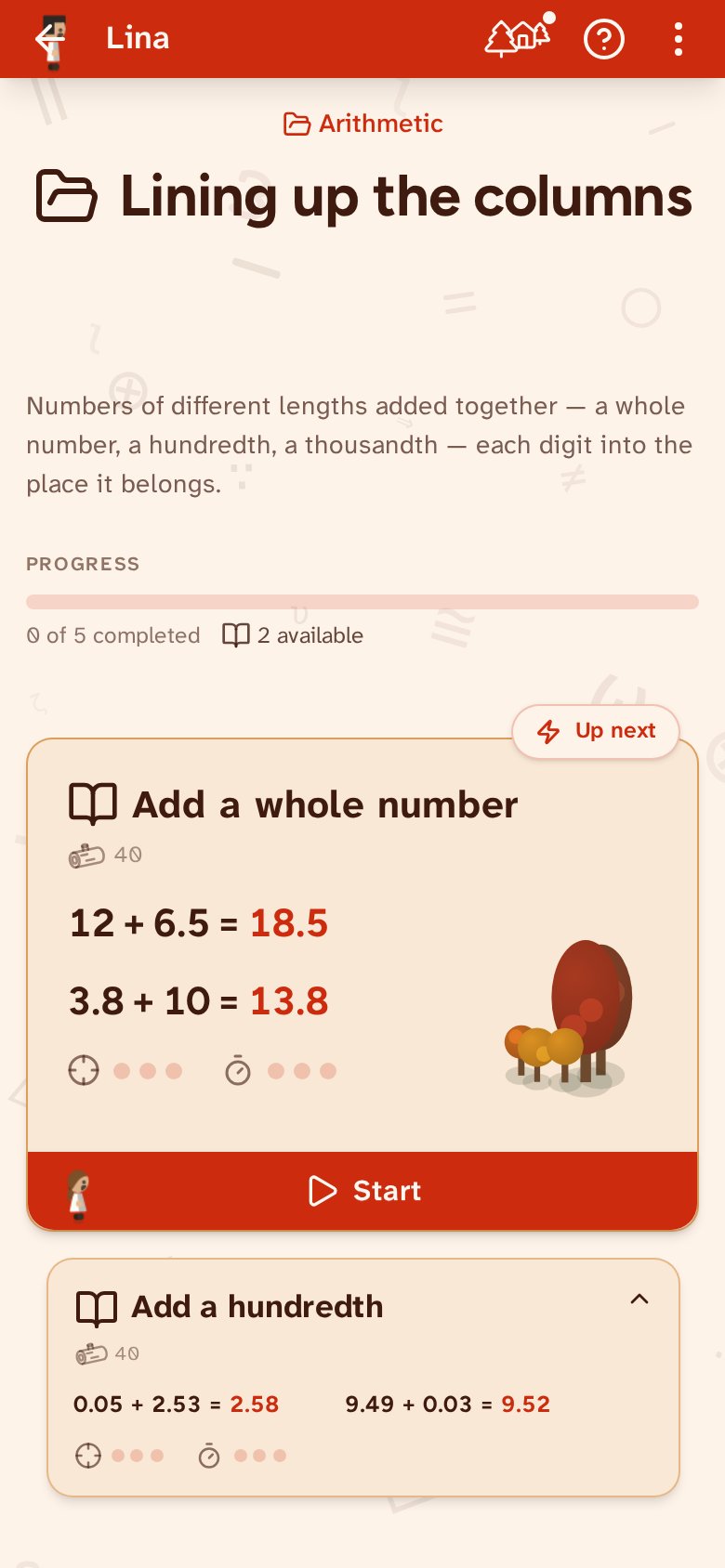
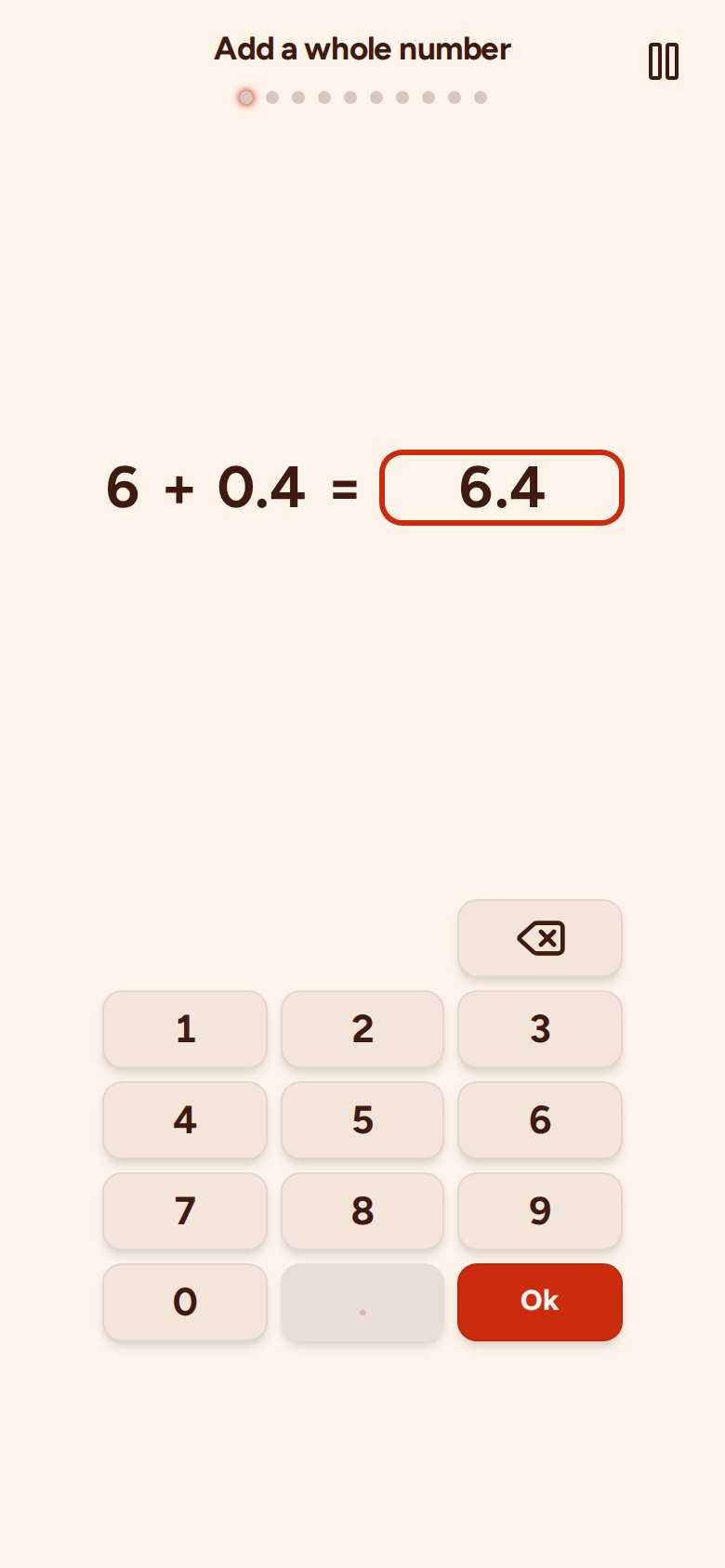
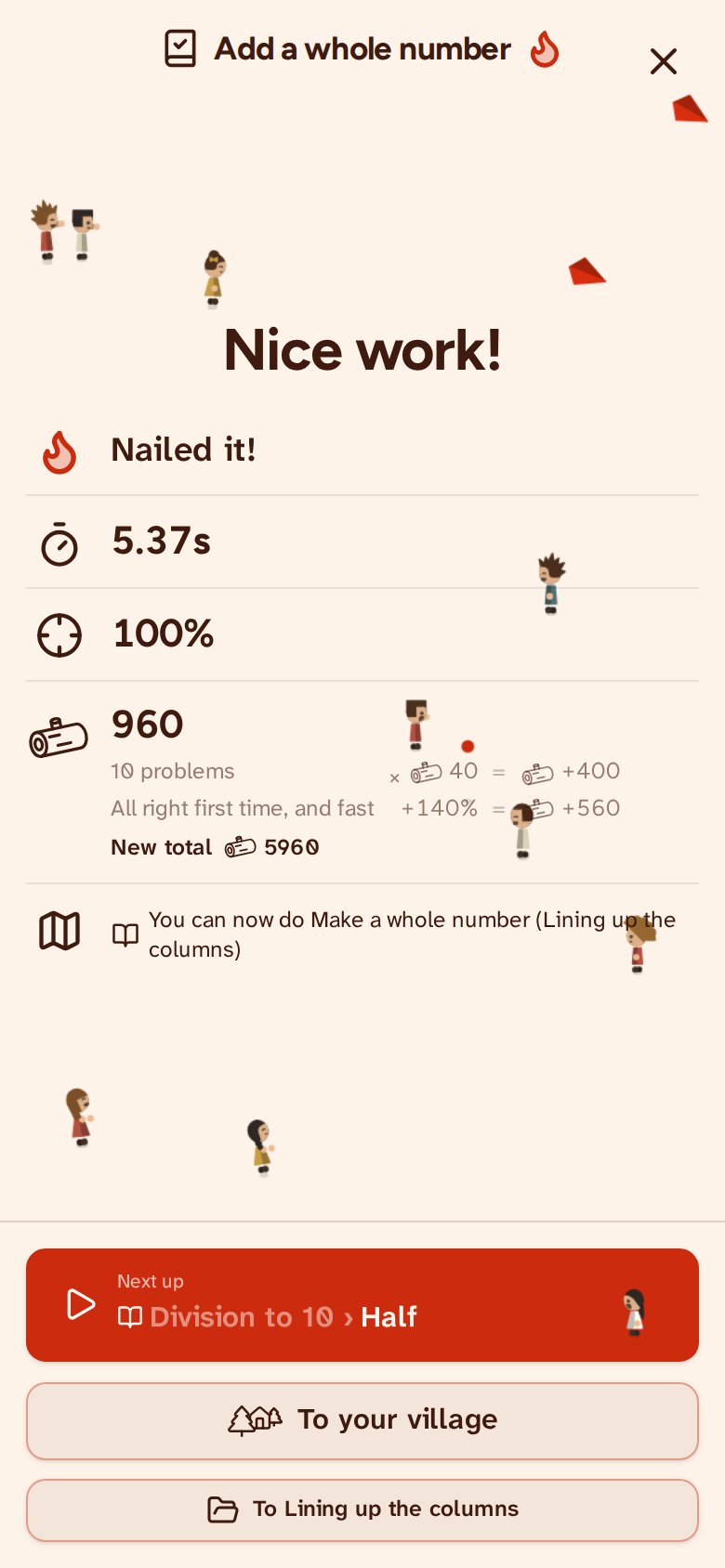
With one exercise from this topic as the example: Add a whole number.
1
2
3
4
How it fits together
The arrows point to what can be done next. Whatever sits inside a box belongs to it.
Needed first
Explore
Decimals
Reading a decimal
Lining up the columns
Adding and subtracting
Moving the decimal point
+1 more
All together
first this, then that belongs to
Reading a decimal
Lining up the columns
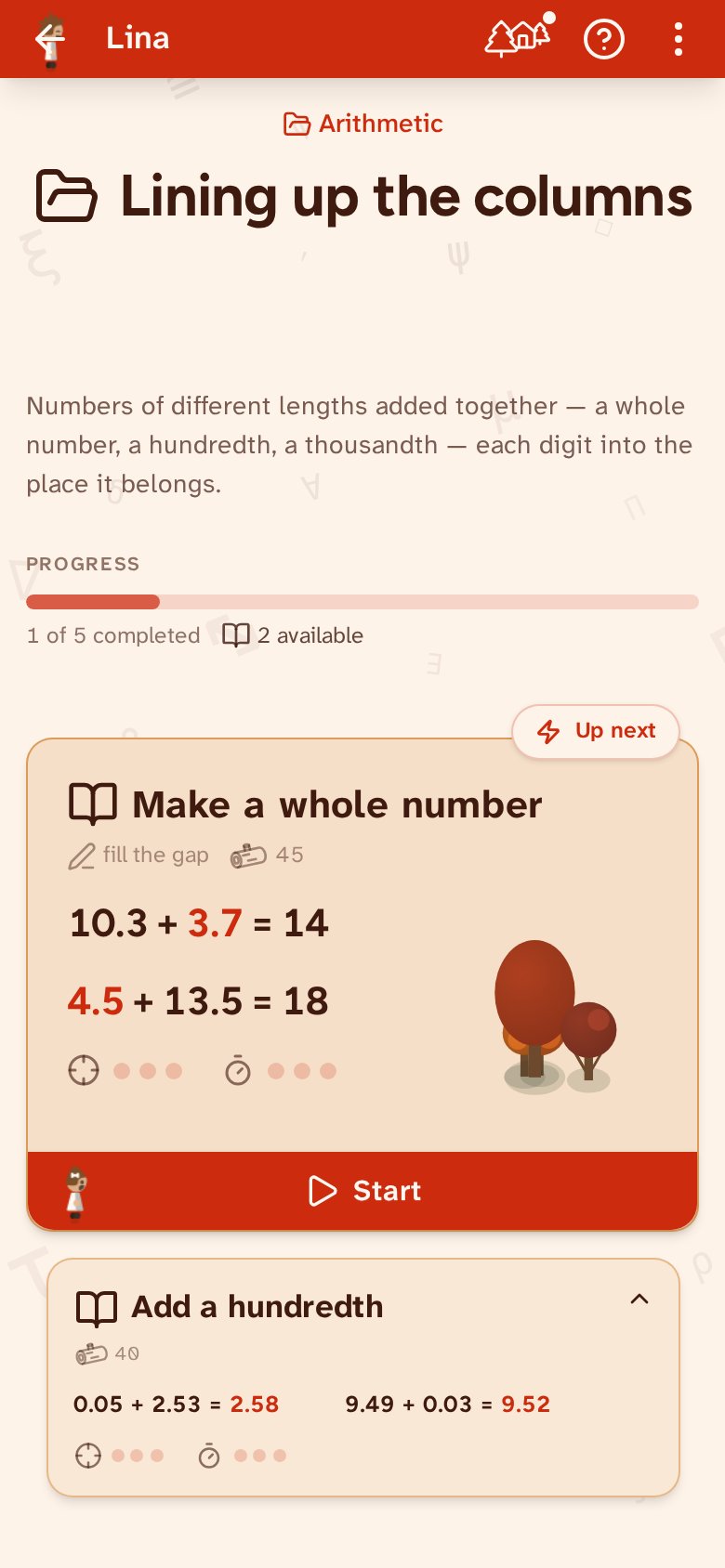
A whole number below 20 plus a decimal number. The tenths do not change.
Which number is missing? The two together make a whole number.
Numbers with two decimals, like 3.42 + 0.05. Which column does the small number go in?
Numbers with three decimals, like 3.140 + 0.005. The last place counts even when it is empty.
0.3, 0.04 or 0.005 added to numbers of every length. Line up the columns first.
Adding and subtracting
The tenths stay under ten, so nothing crosses the point.
Sometimes the tenths make more than ten together, and then one moves into the whole number.
Every column is big enough to take from, so nothing is borrowed.
Two decimal numbers, with carrying or without.
The tenths are too few to take from, so you borrow a whole: that is ten tenths.
One decimal number from another, with borrowing or without.
Adding and subtracting decimals, mixed together
Moving the decimal point
Every digit moves one place to the left: 4.5 × 10 = 45.
Every digit moves one place to the right: 45 ÷ 10 = 4.5.
Two places this time: 4.5 × 100 = 450 and 0.004 × 100 = 0.4.
Two places back: 450 ÷ 100 = 4.5 and 0.4 ÷ 100 = 0.004.
Three places at once: 24.64 × 1000 = 24640.
Three places at once: 24640 ÷ 1000 = 24.64.
All three mixed up, so you read the multiplier before you move the point.
All three mixed up. Read the divisor first, then move the point.
Both ways and all three powers: which way the point moves, and how far.
All together
80 sums in a row, everything mixed: the real test.
Why it matters
Decimals are everywhere: prices, distances, the kitchen scales. They build on what a child already knows, tens and ones, but in the other direction: after the decimal point come tenths, hundredths and thousandths.
Most mistakes happen because a child reads a decimal as two separate whole numbers. Then 3.25 seems bigger than 3.5, because 25 is more than 5. A child who knows what each place is worth won't fall for that any more.
How to approach it
It is all about columns. When adding and subtracting, line the decimal points up exactly underneath each other, and fill an empty place with a zero in your head: 4.6 is the same as 4.60. Then 4.6 + 0.07 suddenly becomes clear: 4.67.
When multiplying or dividing by 10, 100 or 1000, the digits move. × 100 means two places to the left, so 0.38 × 100 = 38. Have your child say out loud how many places and which way before writing anything down.
When is it secure?
When your child gets all 10 sums right in 40 seconds or less. Answers only come that quickly once they come from memory.