Check each sum first: is it plus or minus?
Subtraction to 100
Subtraction to 100 practice, from 87 − 7 to 63 − 57 = 6: a single digit first, then one 2-digit number from another, back across ten, and from 100 up.
Your child can start here once they can add within 100 and subtract within 50. In 64 − 27 the tens, the ones and the step back across a ten all come at once, so each of them has to be routine already, or the sum falls apart into separate tricks.
Usually taught in Year 2–3 in England and Wales, around ages 6 to 8. Every child goes at their own pace; this is a guide, not a requirement.
The first of 32 exercises in this topic. See them all
What it looks like for your child
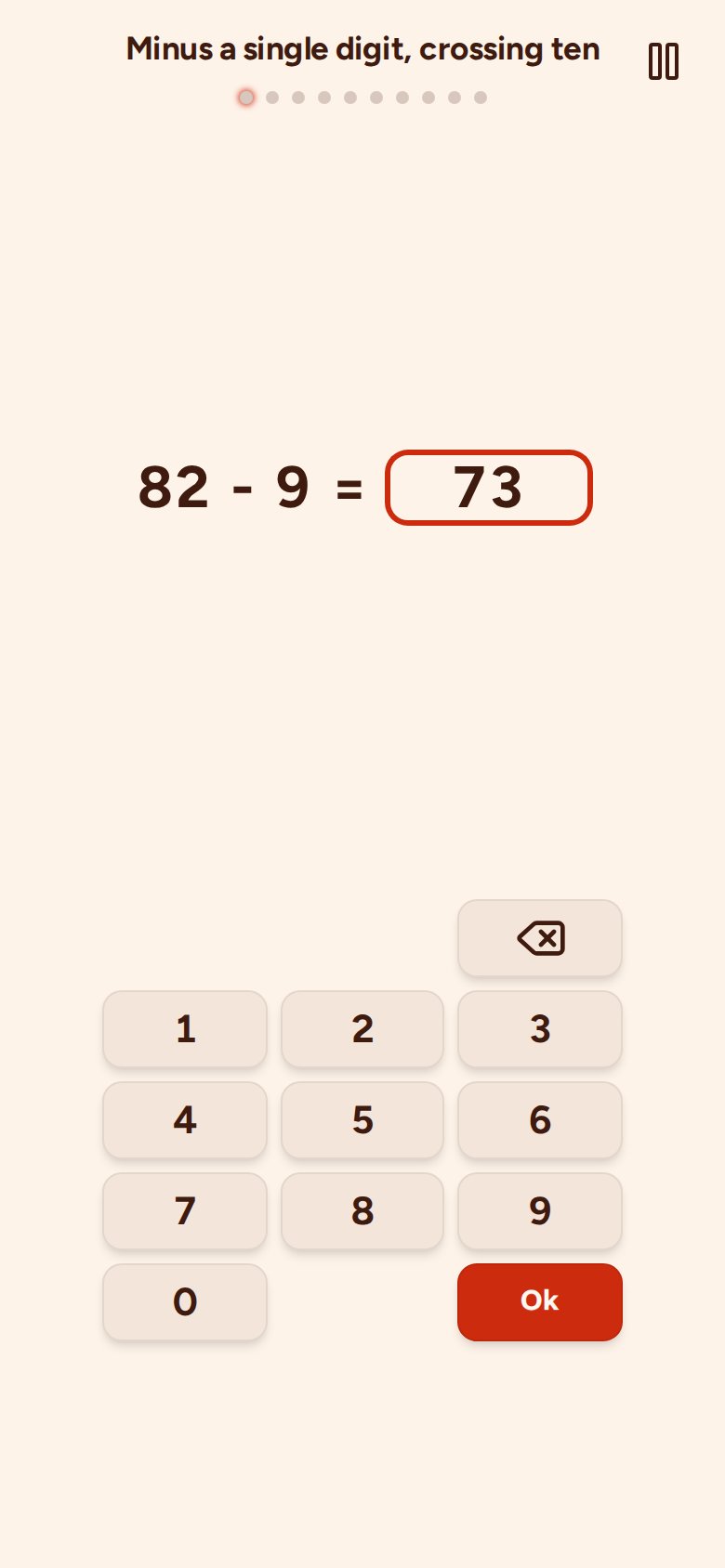
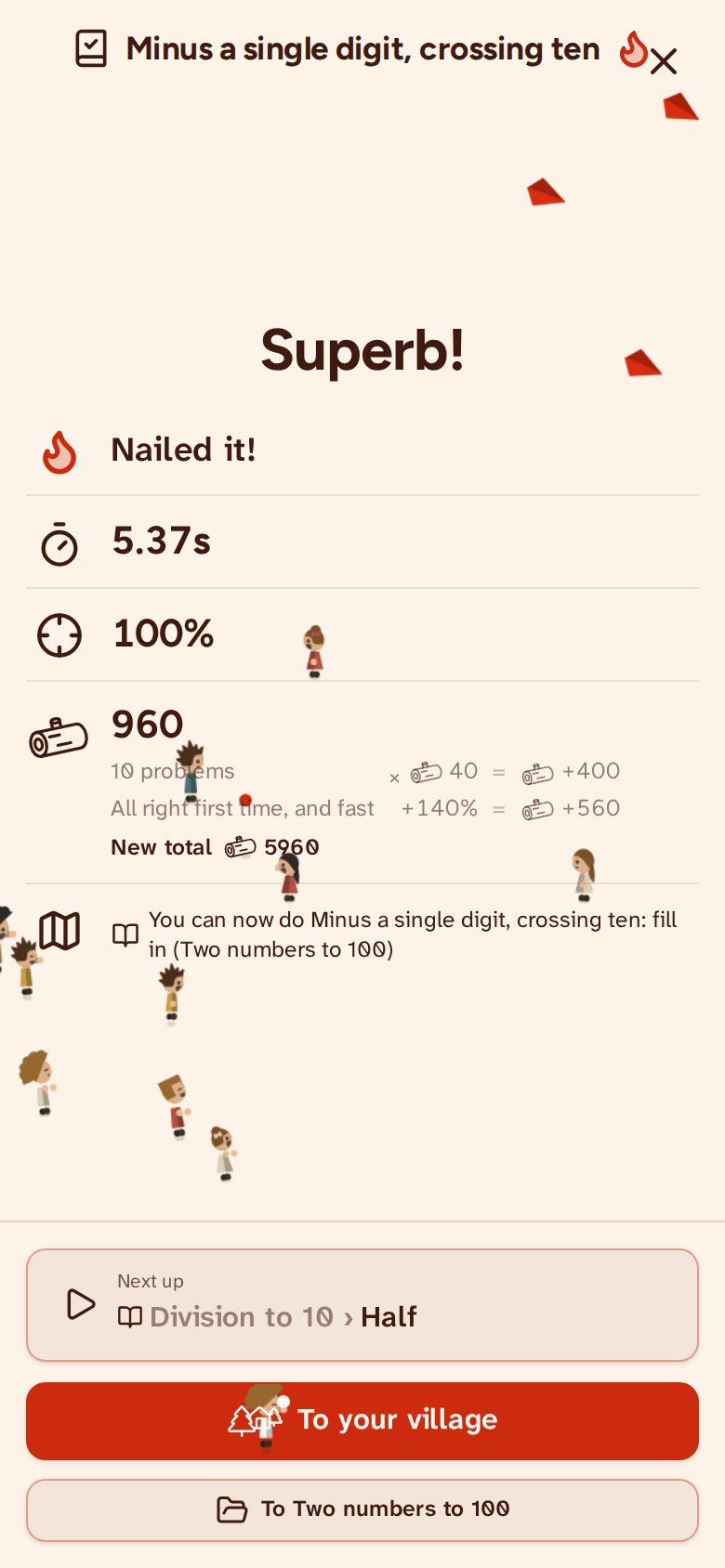
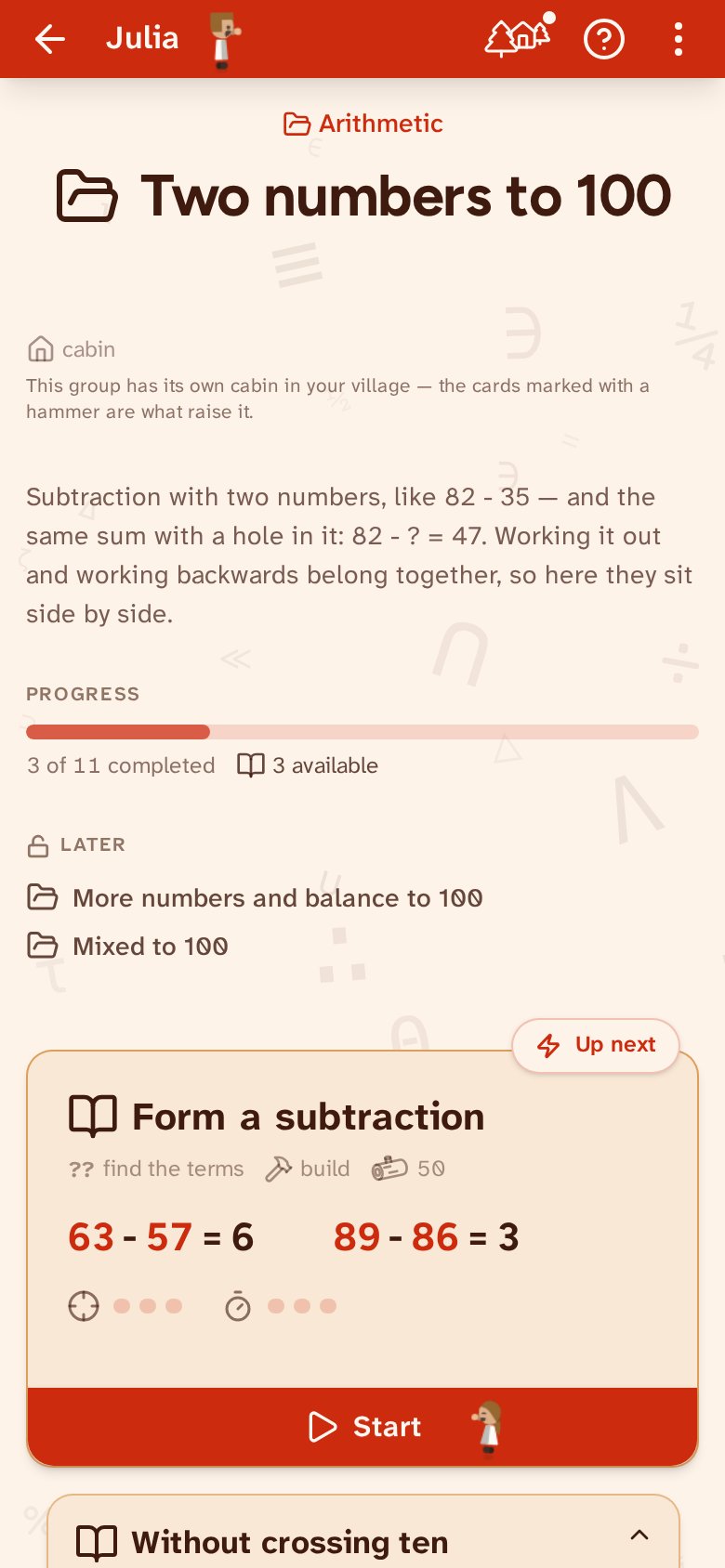
With one exercise from this topic as the example: Minus a single digit, crossing ten.
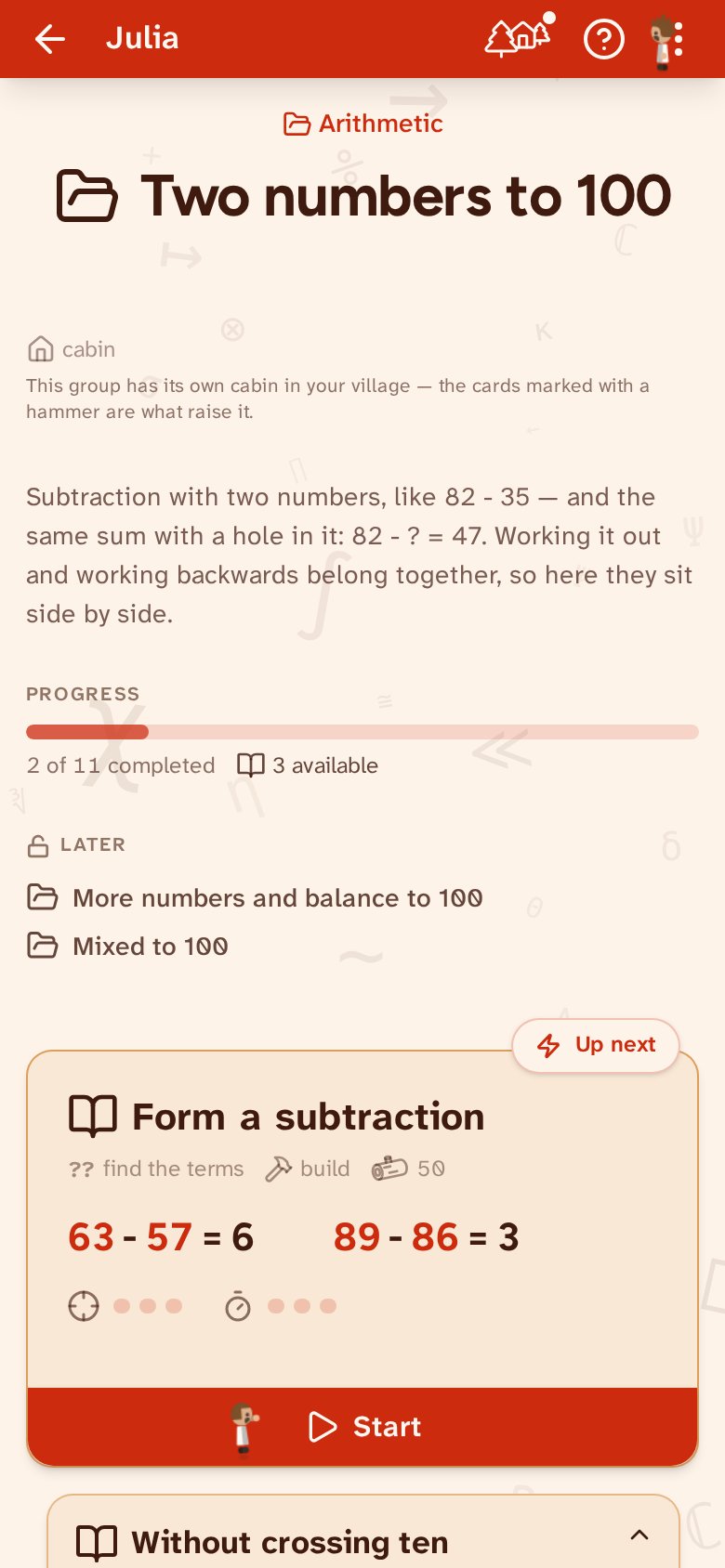
1
2
3
4
How it fits together
The arrows point to what can be done next. Whatever sits inside a box belongs to it.
Subtraction
Subtraction to 100
Two numbers to 100
+3 more
More numbers and balance to 100
Can come next
first this, then that belongs to
Read the whole sum before you fill in: is something added, or taken away?
Against the clock: how many can your child do in sixty seconds?
Left to right, one step at a time.
Work out one side, then make the other side the same.
A long round of 50 mixed sums to finish.
Everything in this topic in one round of 50 sums.
Two numbers to 100
58 − 3: just the ones, 8 − 3 = 5, so 55.
Which two numbers give this difference? Tap them in the right order.
Tens from tens, ones from ones: 75 − 32 = 40 + 3 = 43.
Back to the ten first: 63 − 5 = 63 − 3 − 2 = 58.
Turn it round: 58 − ? = 55 is the same as 55 + ? = 58.
Tens off first, then the ones: 82 − 35 = 52 − 5 = 47.
Turn it round: 75 − ? = 43 is the same as 43 + ? = 75.
Turn it round: 63 − ? = 58 is the same as 58 + ? = 63.
Count up from the small number: 100 − 54 — from 54 to 60 is 6, then 40 more, so 46.
Look first: can you take the ones away without going back past ten?
Turn it round: 82 − ? = 47 is the same as 47 + ? = 82.
More numbers and balance to 100
Take them away one at a time, left to right.
Work out one side, then make the other side the same.
Work out what is already there first, then see how much is missing.
Against the clock: how many can your child do in sixty seconds?
Take them away one at a time, left to right.
A race against time, for children who can already do it and want to be faster.
Work out what is already there first, then see how much is missing.
Mixed to 100
The same sum as 82 − 35 = 47, but ten times bigger: 820 − 350 = 470.
Against the clock: how many can your child do in sixty seconds?
The same sum as 82 − 35 = 47, but a hundred times bigger: 8200 − 3500 = 4700.
Just like 100 − 45 = 55, but ten times bigger: 1000 − 450 = 550.
The same sum as 82 − 35 = 47, but a thousand times bigger: 82000 − 35000 = 47000.
Just like 100 − 45 = 55, but a hundred times bigger: 10000 − 4500 = 5500.
Just like 100 − 45 = 55, but a thousand times bigger: 100000 − 45000 = 55000.
Why it matters
To 100, all the earlier steps come together. Your child subtracts one 2-digit number from another, sometimes crossing back over a ten, and has to see for each sum which approach is shortest. Here subtraction becomes a real skill instead of a list of separate tricks.
What goes smoothly here, your child will use everywhere: change from a purchase, the time that is left, the difference between two scores. The sums with hundreds and thousands follow on from this as well, because 900 − 350 is really 90 − 35 in bigger clothes.
How to approach it
If there are enough ones, your child can subtract the tens and the ones separately. If not, as in 64 − 27, working in steps is safer: first take away 20 to get to 44, then 4 to get to 40, then 3 more, so 37. Write a route like that down together a few times, so your child sees the pattern.
Sometimes it helps to see subtraction as a distance. For 71 − 38, draw an empty number line and measure in jumps how far 38 is from 71: to 40 is 2, to 70 is 30, to 71 is 1. That makes 33. Especially with numbers close together, this is quicker than taking away.
When is it secure?
When your child gets all 10 sums right in 35 seconds or less. Answers only come that quickly once they come from memory.