Check each sum first: is it plus or minus?
Subtraction to 50
Subtraction to 50 practice, from 46 − 2 to 50 − 31 = 19: across every ten up to 50, then three or four numbers, balance sums and plus and minus mixed.
Your child can start here once they can add within 50 and subtract within 30. With four tens in play the answer is no longer close to the starting number, so a child still counting back one by one loses count, while one who handles each ten securely can jump.
Usually taught in Year 2 in England and Wales, around ages 6 to 7. Every child goes at their own pace; this is a guide, not a requirement.
The first of 28 exercises in this topic. See them all
What it looks like for your child
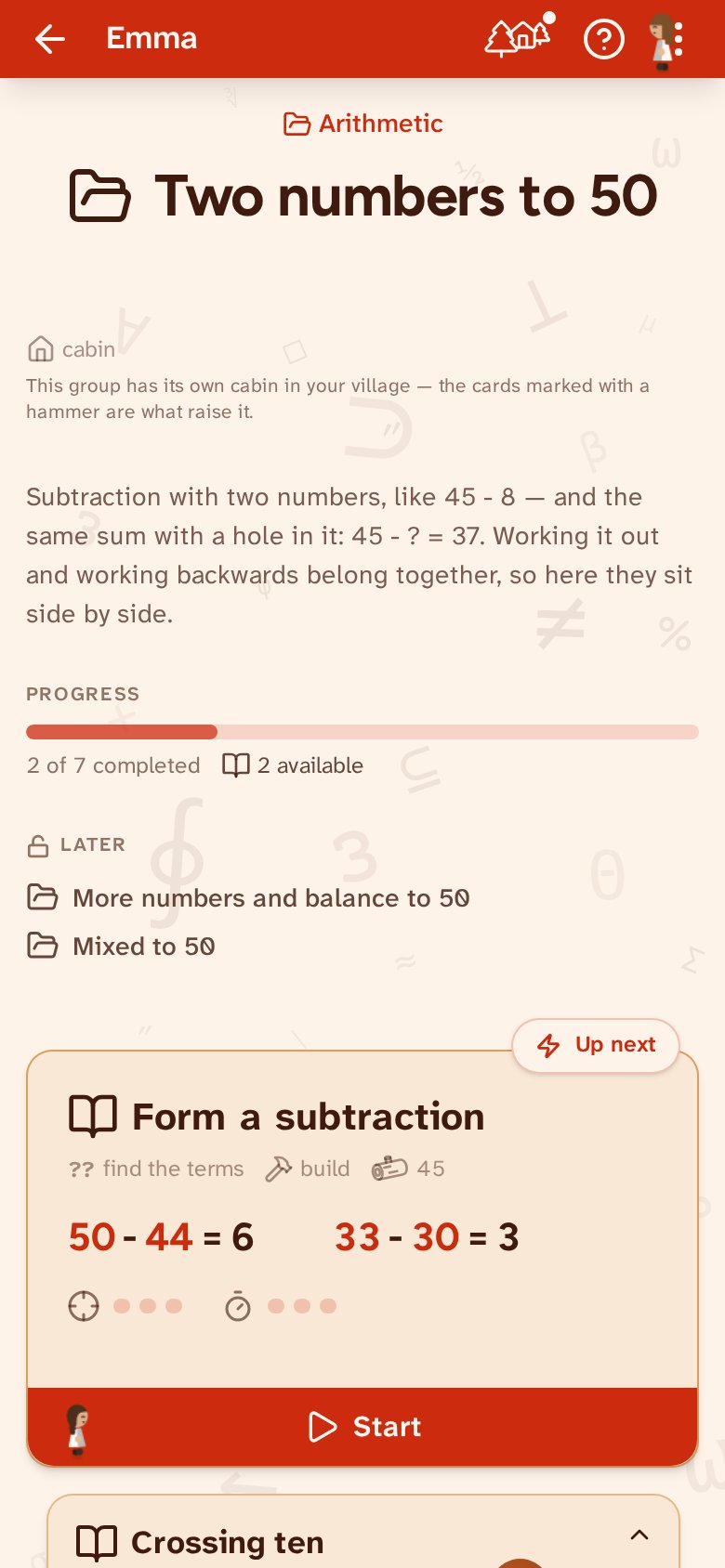
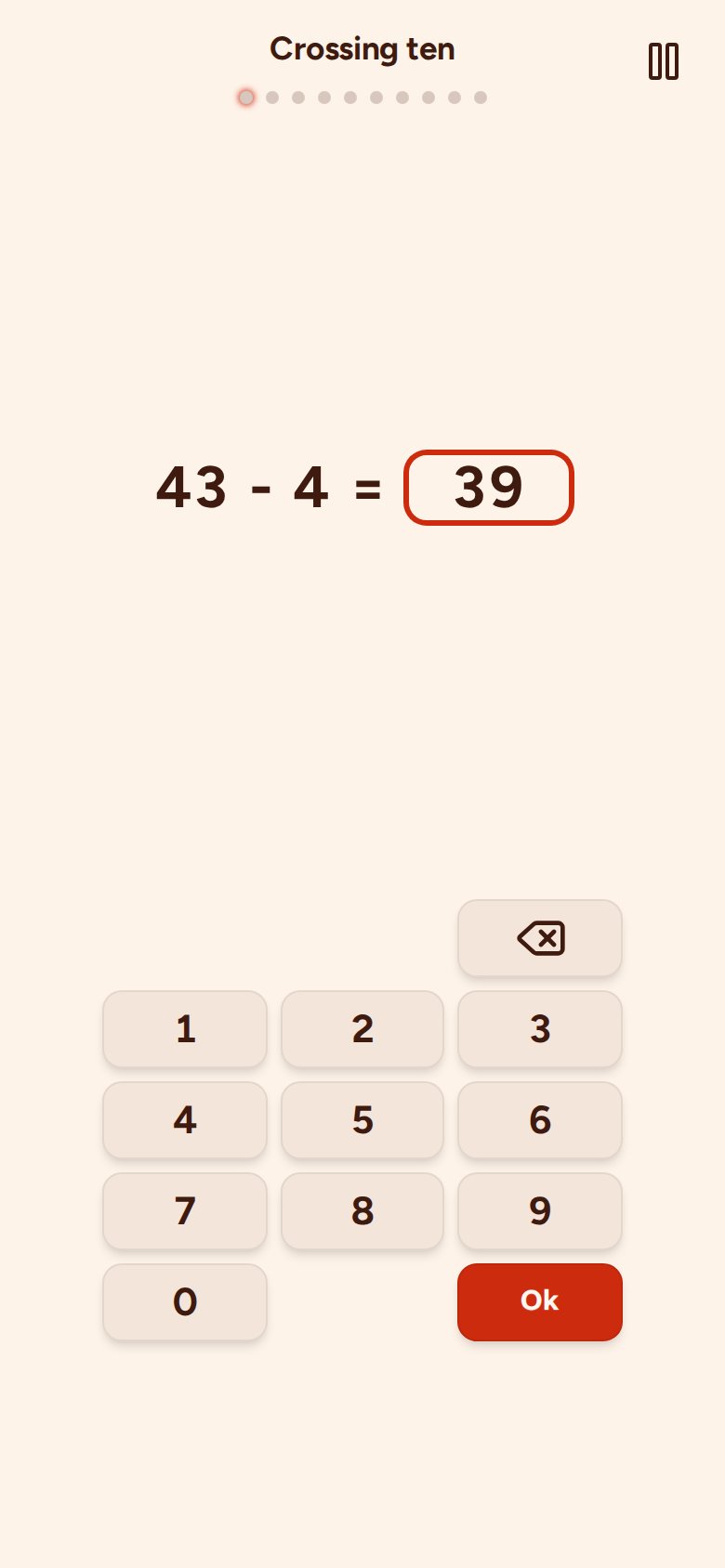
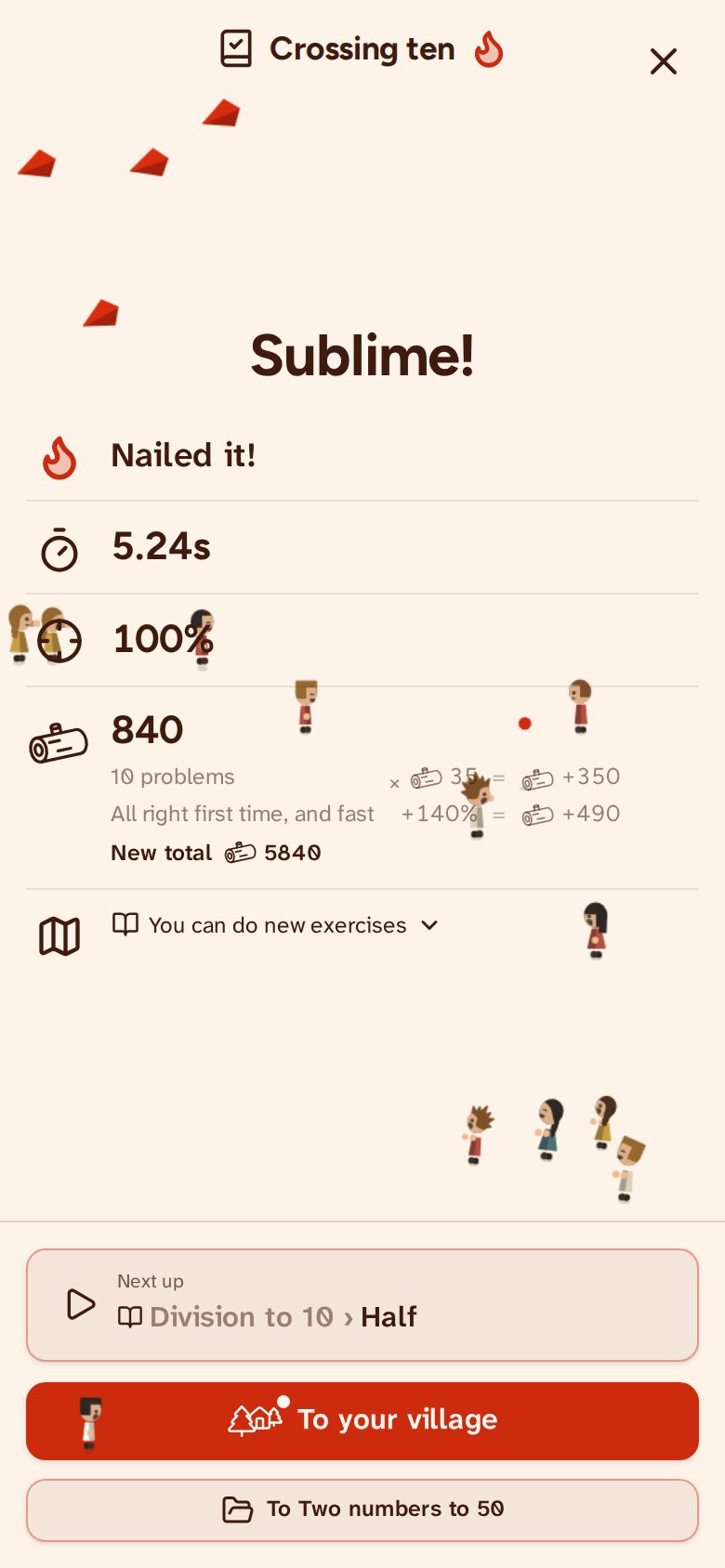
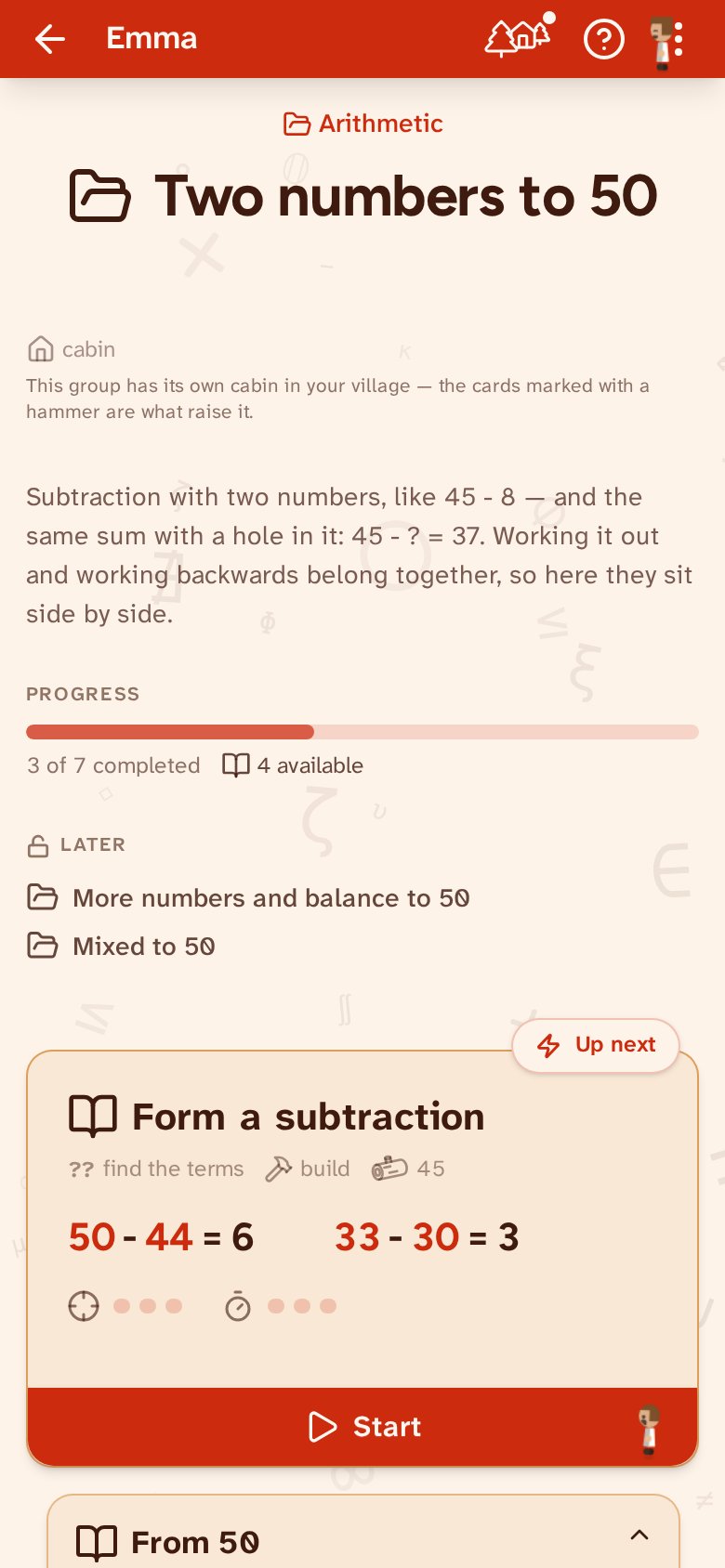
With one exercise from this topic as the example: Crossing ten.
1
2
3
4
How it fits together
The arrows point to what can be done next. Whatever sits inside a box belongs to it.
Subtraction
Subtraction to 50
Two numbers to 50
More numbers and balance to 50
Can come next
first this, then that belongs to
Read the whole sum before you fill in: is something added, or taken away?
Left to right, one step at a time.
Work out one side, then make the other side the same.
30 sums in a row, everything mixed: the real test.
One minute, as many sums as possible. Not needed to move on, but good for getting quicker.
50 sums in a row, everything mixed: the real test.
Two numbers to 50
Which two numbers give this difference? Tap them in the right order.
47 − 5: just the ones, 7 − 5 = 2, so 42.
Back to the ten first: 43 − 8 = 43 − 3 − 5 = 35.
Turn it round: 47 − ? = 42 is the same as 42 + ? = 47.
Count up from the small number: 50 − 27 — from 27 to 30 is 3, then 20 more, so 23.
Turn it round: 43 − ? = 35 is the same as 35 + ? = 43.
Look first: can you take the ones away without going back past ten?
More numbers and balance to 50
Take them away one at a time, left to right.
Work out one side, then make the other side the same.
Work out what is already there first, then see how much is missing.
Against the clock: how many can your child do in sixty seconds?
Take them away one at a time, left to right.
Against the clock: how many can your child do in sixty seconds?
Work out what is already there first, then see how much is missing.
Mixed to 50
The same sum as 43 − 8 = 35, but ten times bigger: 430 − 80 = 350.
One minute, as many sums as possible. Not needed to move on, but good for getting quicker.
The same sum as 43 − 8 = 35, but a hundred times bigger: 4300 − 800 = 3500.
Just like 50 − 24 = 26, but ten times bigger: 500 − 240 = 260.
The same sum as 43 − 8 = 35, but a thousand times bigger: 43000 − 8000 = 35000.
Just like 50 − 24 = 26, but a hundred times bigger: 5000 − 2400 = 2600.
Just like 50 − 24 = 26, but a thousand times bigger: 50000 − 24000 = 26000.
Why it matters
To 50, little changes in the kind of sums; what changes is the room. Your child now works with four tens and has to keep track of them. In 45 − 19 the answer is no longer right next to the starting number, and a child still counting back on their fingers loses count.
That makes this step the point where handy strategies are really needed. A child who learns here to jump in tens will soon subtract to 100 without paper. And the balance with numbers up to 50 trains something that keeps coming back in maths: two sides that have to weigh the same.
How to approach it
A handy trick with numbers just below a ten is ‘take away too much, then add back’. For 42 − 19, take away 20, which gives 22, and because you took away one too many, add it back: 23. Many children enjoy this once they see that it works.
Teach your child to check an answer with an addition now and then, too. If 47 − 18 = 29, then 29 + 18 should be 47 again. The check takes a few seconds, and a child who is used to it catches their own mistakes before anyone else sees them.
When is it secure?
A round of 10 sums in one go without a mistake, within 30 seconds. That is about 3 seconds a sum: no more counting, just knowing.