Choose two numbers that make the total together
Addition to 50
Adding to 50 practice, from 35 + 4 to 27 + 7 = 34: tens and ones as building blocks, crossing every ten, then three or four numbers and balance sums.
Your child can start here once they can add and subtract within 30 and find their way on the number line. With four tens to keep track of, fingers are no help any more, so the method for crossing a ten has to be secure before the numbers get this big.
Usually taught in Year 2 in England and Wales, around ages 6 to 7. Every child goes at their own pace; this is a guide, not a requirement.
The first of 22 exercises in this topic. See them all
What it looks like for your child
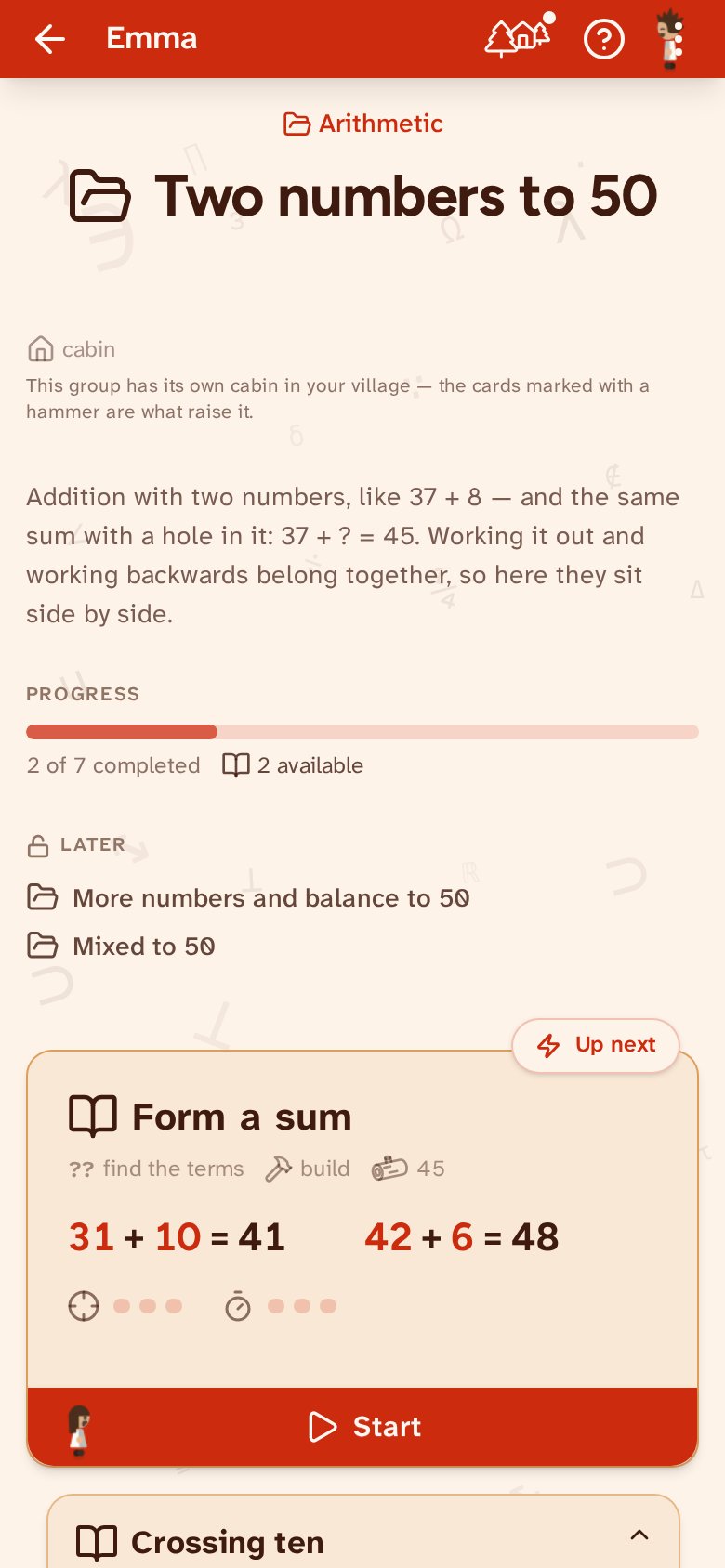
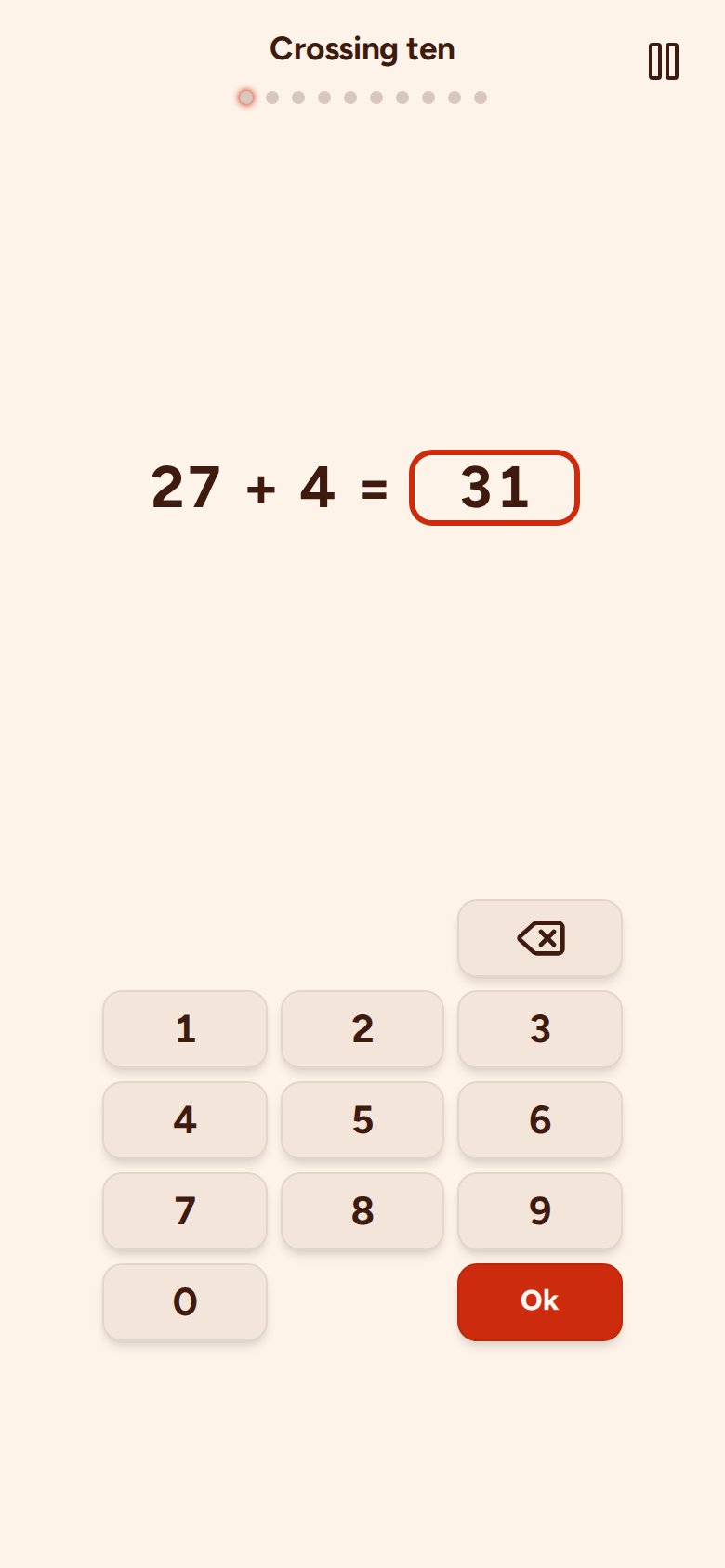
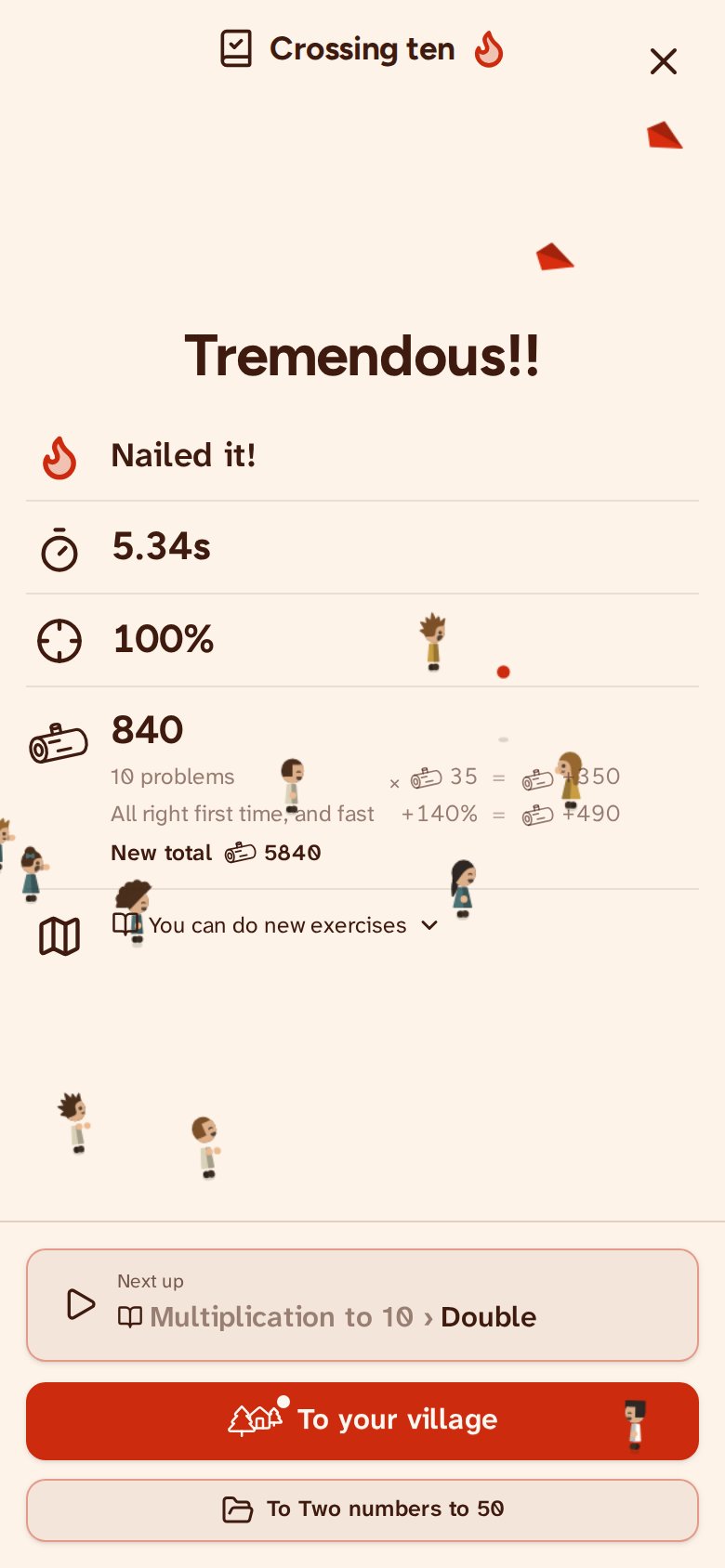
With one exercise from this topic as the example: Crossing ten.
1
2
3
4
How it fits together
The arrows point to what can be done next. Whatever sits inside a box belongs to it.
Addition
Addition to 50
Two numbers to 50
More numbers and balance to 50
All together
Can come next
first this, then that belongs to
Two numbers to 50
42 + 5: just add the ones, 2 + 5 = 7, so 47.
Jump to the next ten first: 37 + 8 = 37 + 3 + 5 = 45.
Turn it round: ? + 5 = 47 is the same as 47 − 5.
Jump to the next ten first: ? + 24 = 50 — from 24 to 30 is 6, then 20 more, so 26.
Turn it round: ? + 8 = 45 is the same as 45 − 8.
Look first: do the ones add up past ten?
More numbers and balance to 50
Look for numbers that make a round number together first, like 7 + 3.
Work out one side, then make the other side the same.
Work out what is already there first, then see how much is missing.
A race against time, for children who can already do it and want to be faster.
Look for numbers that make a round number together first, like 7 + 3.
A race against time, for children who can already do it and want to be faster.
Work out what is already there first, then see how much is missing.
Mixed to 50
The same sum as 37 + 8 = 45, but ten times bigger: 370 + 80 = 450.
One minute, as many sums as possible. Not needed to move on, but good for getting quicker.
The same sum as 37 + 8 = 45, but a hundred times bigger: 3700 + 800 = 4500.
Just like 24 + 26 = 50, but ten times bigger: 240 + 260 = 500.
The same sum as 37 + 8 = 45, but a thousand times bigger: 37000 + 8000 = 45000.
Just like 24 + 26 = 50, but a hundred times bigger: 2400 + 2600 = 5000.
Just like 24 + 26 = 50, but a thousand times bigger: 24000 + 26000 = 50000.
All together
Everything in this topic in one round of 50 sums.
- Plus and minus — on the Subtraction to 50 page
- Plus and minus: fill in — on the Subtraction to 50 page
- Plus and minus: three numbers — on the Subtraction to 50 page
- Plus and minus: balance — on the Subtraction to 50 page
- Plus and minus: big round — on the Subtraction to 50 page
- Quick: plus and minus — on the Subtraction to 50 page
Why it matters
To 50, what mainly changes is the scale. There are more tens to keep track of, and counting on fingers is definitely no longer an option. Your child needs to see a number as tens plus ones, and move them around with ease.
That understanding, that a digit means something different in a different place, is one of the most important things a child builds up in maths. It will be there in column addition, in decimals and in every estimate with big numbers. So this step is not a repeat of addition to 30, but a practice ground for that one idea.
How to approach it
You can make tens and ones easy to handle with lolly sticks and elastic bands: bundles of ten and single sticks. Lay out 26 and 17, push the bundles together first and then the singles. If there are ten or more singles, your child makes a new bundle from them. Crossing ten becomes something you can watch happen.
In ‘Form a sum’ your child looks for two numbers that make the answer together. Try it at home with a target: ‘make 45 together’. There are many right answers, and talking about which one is handiest teaches your child more than finding one right answer.
When is it secure?
A round of 10 sums in one go without a mistake, within 45 seconds. That is about 4.5 seconds a sum: no more counting, just knowing.