Both ends are labelled; the arrow points to a number in between. Which one is it?
The number line
Number line practice, from placing 7 between 1 and 10 to jumping in fives and tens: first a line to 10, then to 20, then to 50 and 100.
This is where it starts: nothing else needs to come first. Adding and subtracting build on it, because once a number is also a place on a line, every sum becomes a jump forwards or back.
Usually taught in Year 1–2 in England and Wales, around ages 5 to 7. Every child goes at their own pace; this is a guide, not a requirement.
The first of 31 exercises in this topic. See them all
What it looks like for your child
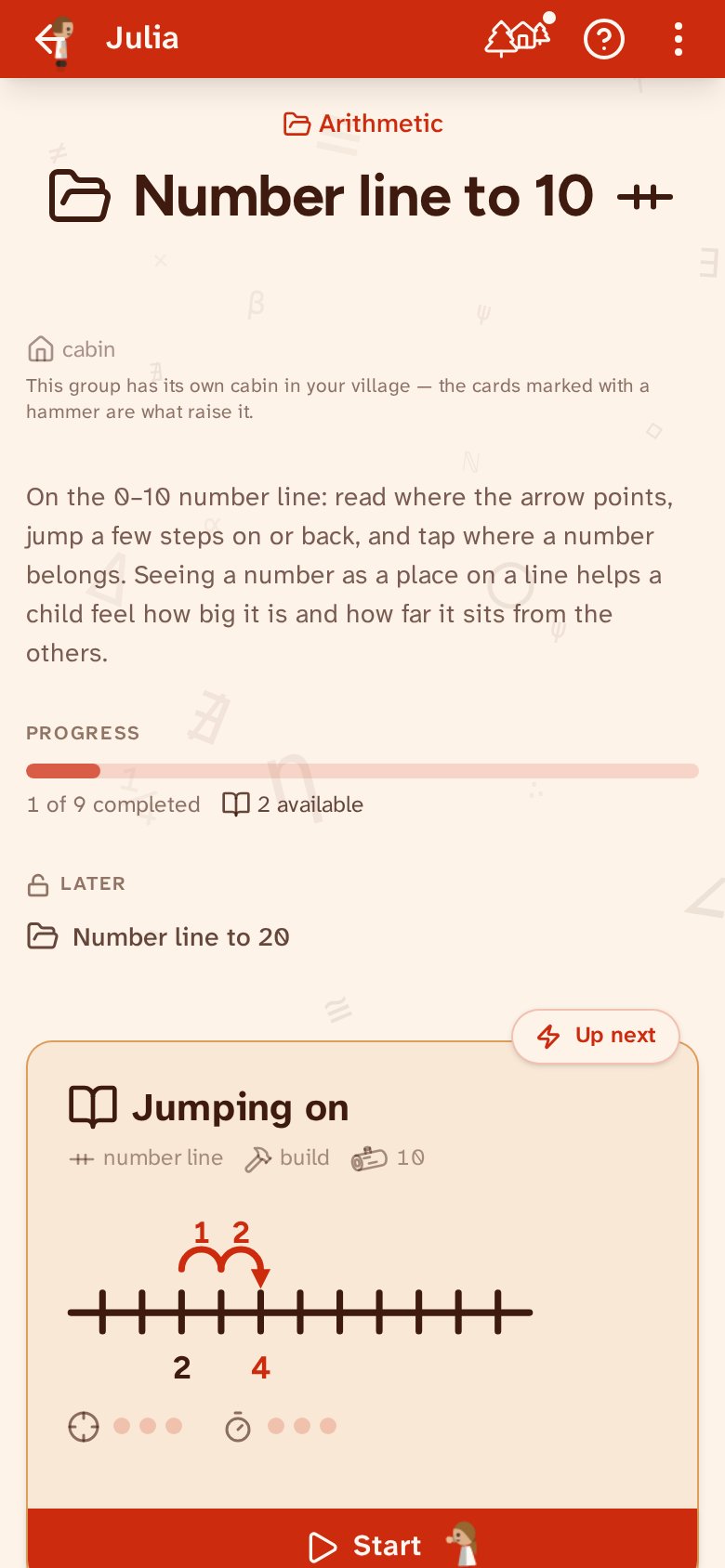
With one exercise from this topic as the example: Jumping on.
1
2
3
4
How it fits together
The arrows point to what can be done next. Whatever sits inside a box belongs to it.
Visual maths
The number line
Number line to 10
Number line to 20
+1 more
Number line to 50
first this, then that belongs to
Number line to 10
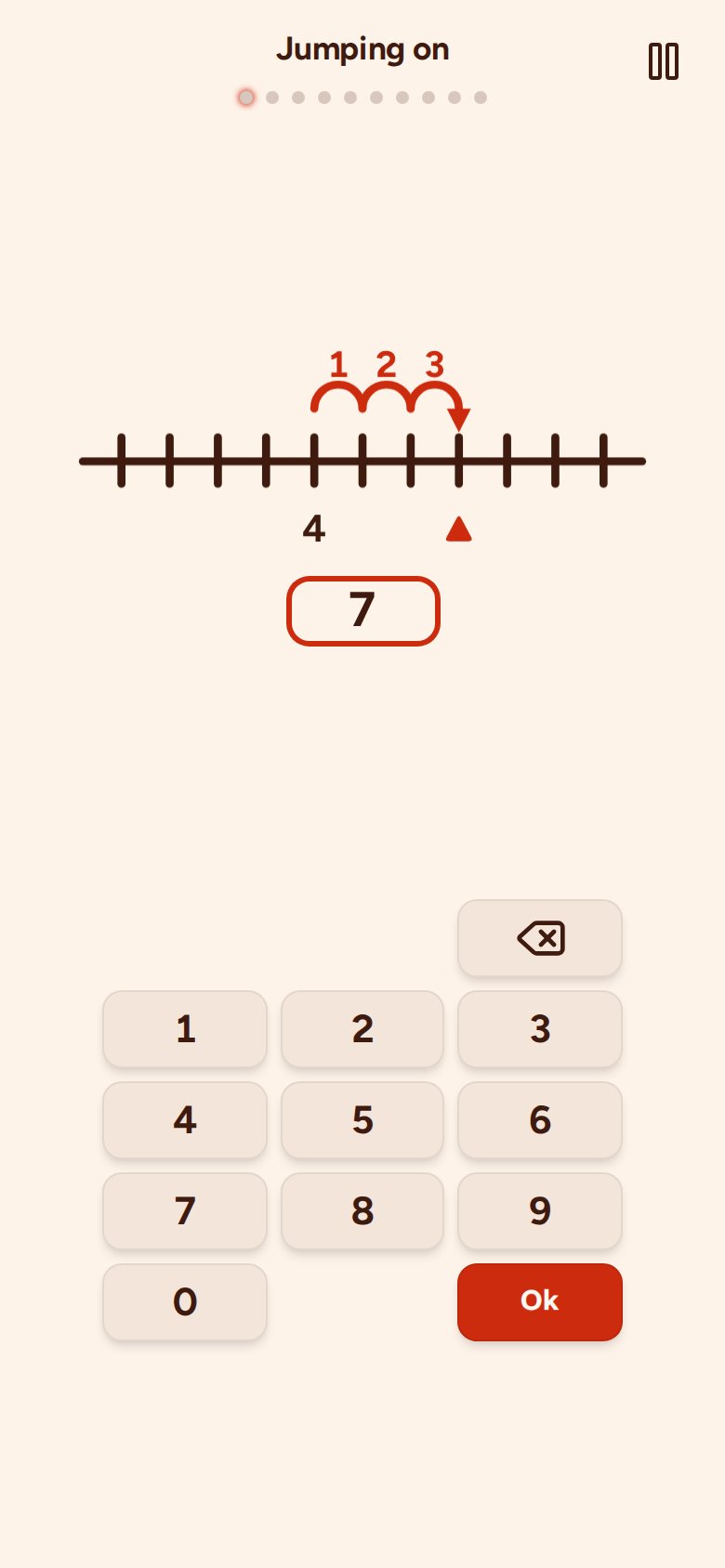
Arcs to the right, one per step and counted 1, 2, 3 — and an arrow where the jump ends. Which number is it?
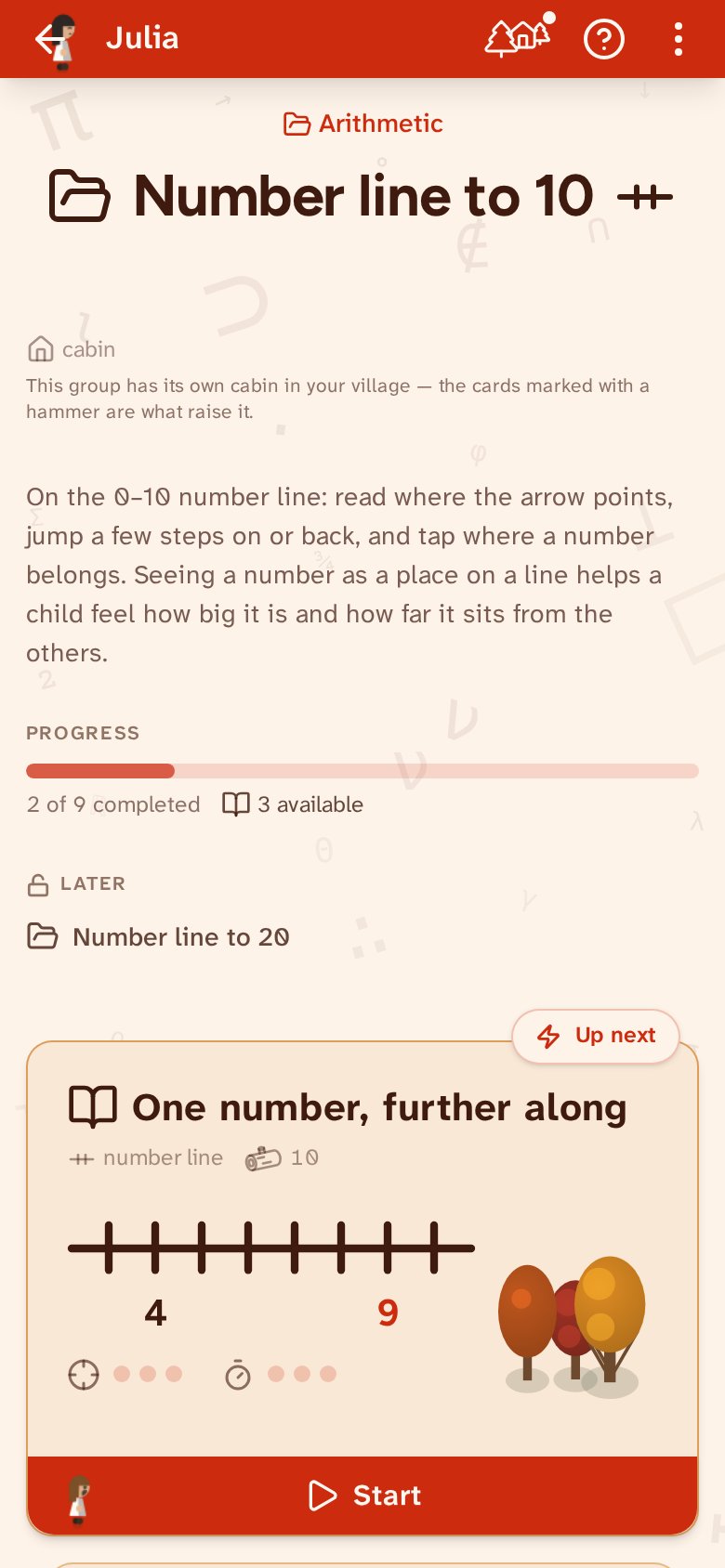
One number is marked on the line. The arrow points further along, past that number. Which number is it?
Now the arcs go back, to the left, counted 1, 2, 3. Where does the arrow land?
One number is marked on the line. The arrow points back the other way, before that number. Which number is it?
One number is marked on the line. Now the arrow can point further along or back — look carefully which way.
You get a number. Tap where it belongs on the line, then press Ok.
Reading, jumping and placing, all mixed. This is the test of the number line to 10.
Number line to 20
The same line, but it starts at 10 and runs up to 20.
Arcs to the right on the line to 20, counted — sometimes across the ten. Where does the arrow land?
One number is marked on the line to 20. The arrow points further along, past that number. Which number is it?
Arcs back on the line to 20, counted — sometimes back across the ten. Where does the arrow land?
One number is marked on the line to 20. The arrow points back, before that number. Which number is it?
Only the 10 is marked. The arrow is a few steps before or after it. Which number is it?
You get a number between 10 and 20. Tap where it belongs on the line, then press Ok.
A stretch of the line to 20 with three numbers on it, and four arrows. Each arrow comes from a box: read where it points and type that number in, left to right.
Everything on the line to 20, mixed. This is the test of the number line to 20.
Number line to 50
Where does the arrow point?
Arcs of five, counted, on or back. Where does the arrow land?
0 and 10 are marked, two marks apart: each mark is 5. Count on to the arrow.
Only the start and the end are marked. Each mark is 10. Where is the arrow?
You get a number from the five times table. Tap where it belongs on the line, then press Ok.
A stretch of the line between 20 and 50 with three numbers on it, and four arrows. Each arrow comes from a box: read where it points and type that number in, left to right.
Everything on the line to 50, mixed. This is the test of the number line to 50.
Number line to 100
A straight line from 50 to 60, 60 to 70, up to 90 to 100, with only its ends labelled. Where does the arrow point?
Arcs of ten, counted, on or back. Where does the arrow land?
Only 0 and 100 are marked. Each mark is 10. Where is the arrow?
0, 50 and 100 are marked, and each mark is 5. Which number is it?
You get a number from the five times table. Tap where it belongs on the line to 100, then press Ok.
A stretch of the line between 50 and 100 with three numbers on it, and four arrows. Each arrow comes from a box: read where it points and type that number in, left to right.
Everything on the line to 100, mixed. This is the test of the number line to 100.
Why it matters
On the number line, a number becomes a place instead of just a name. A child sees that 7 is closer to 10 than to 1, and that 15 sits exactly halfway between 10 and 20. That picture in space helps later with estimating, rounding and making jumps while working out sums.
In Maqqii it is also the door to the rest: from the number line, your child moves on to addition and subtraction.
How to approach it
Have your child look first at what is already there: the start, the end, or one number somewhere on the line. From there you count the marks, forwards or backwards, to where the arrow points. In the last exercises the arrow can point either way, so check which way first.
At home, a ruler or a tape measure works perfectly well as a number line. Point to a spot and ask which number belongs there, or turn it round: where is 13?
When is it secure?
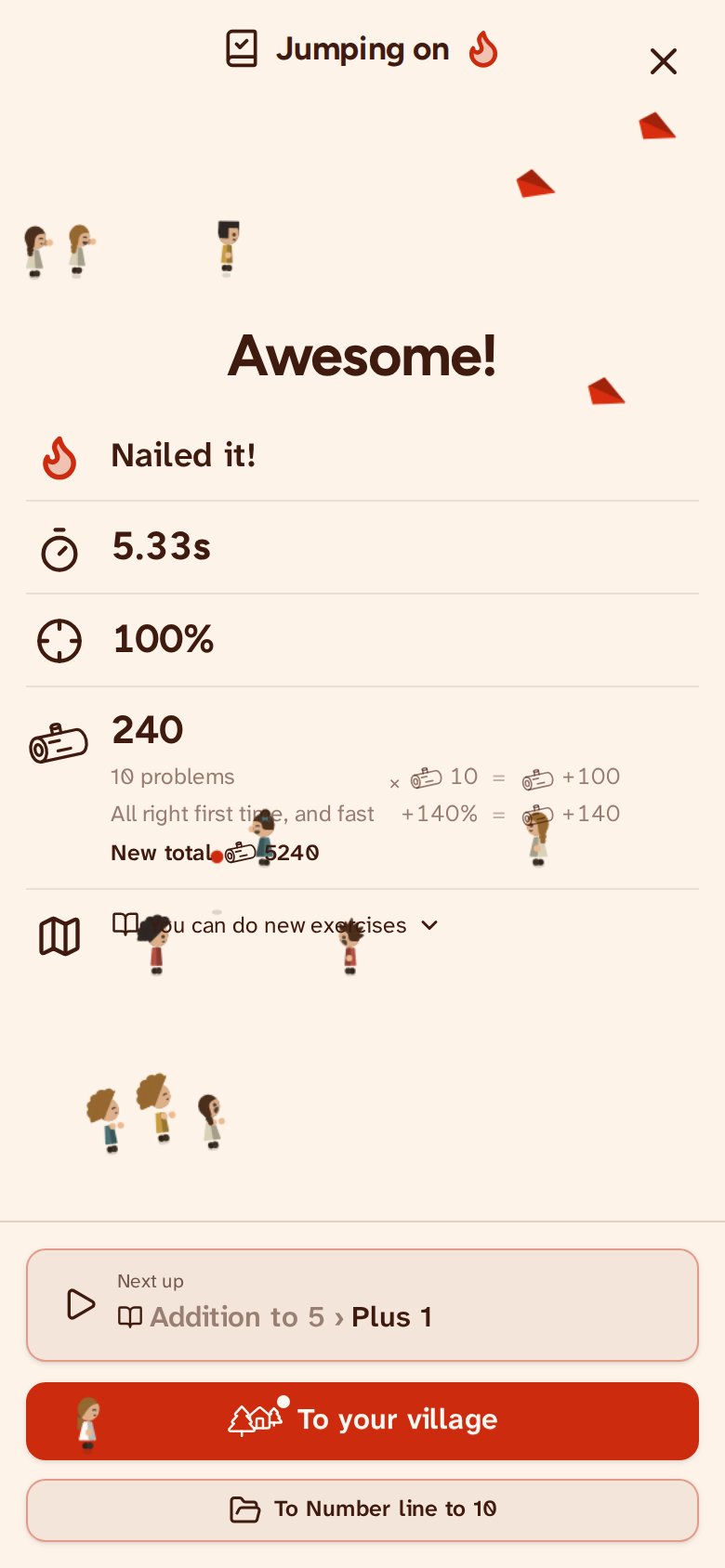
When your child gets all 10 sums right in 50 seconds or less. Answers only come that quickly once they come from memory.