Turn it round: ? + 5 = 13 is the same as 13 − 5.
Addition to 20
Adding to 20 practice, from 13 + 4 to 13 + 7 = 20: sums within the ten first, then sums that cross ten, then three or four numbers and balance sums.
Your child can only do the exercises here once they can add and subtract within 10 and place numbers on the number line. Crossing ten depends on it: for 7 + 6 a child splits the 6 into 3 and 3 to fill up the ten first, and that split is a number bond they need to know without thinking.
Usually taught in Year 1–2 in England and Wales, around ages 5 to 7. Every child goes at their own pace; this is a guide, not a requirement.
The first of 23 exercises in this topic. See them all
What it looks like for your child
With one exercise from this topic as the example: Crossing ten.
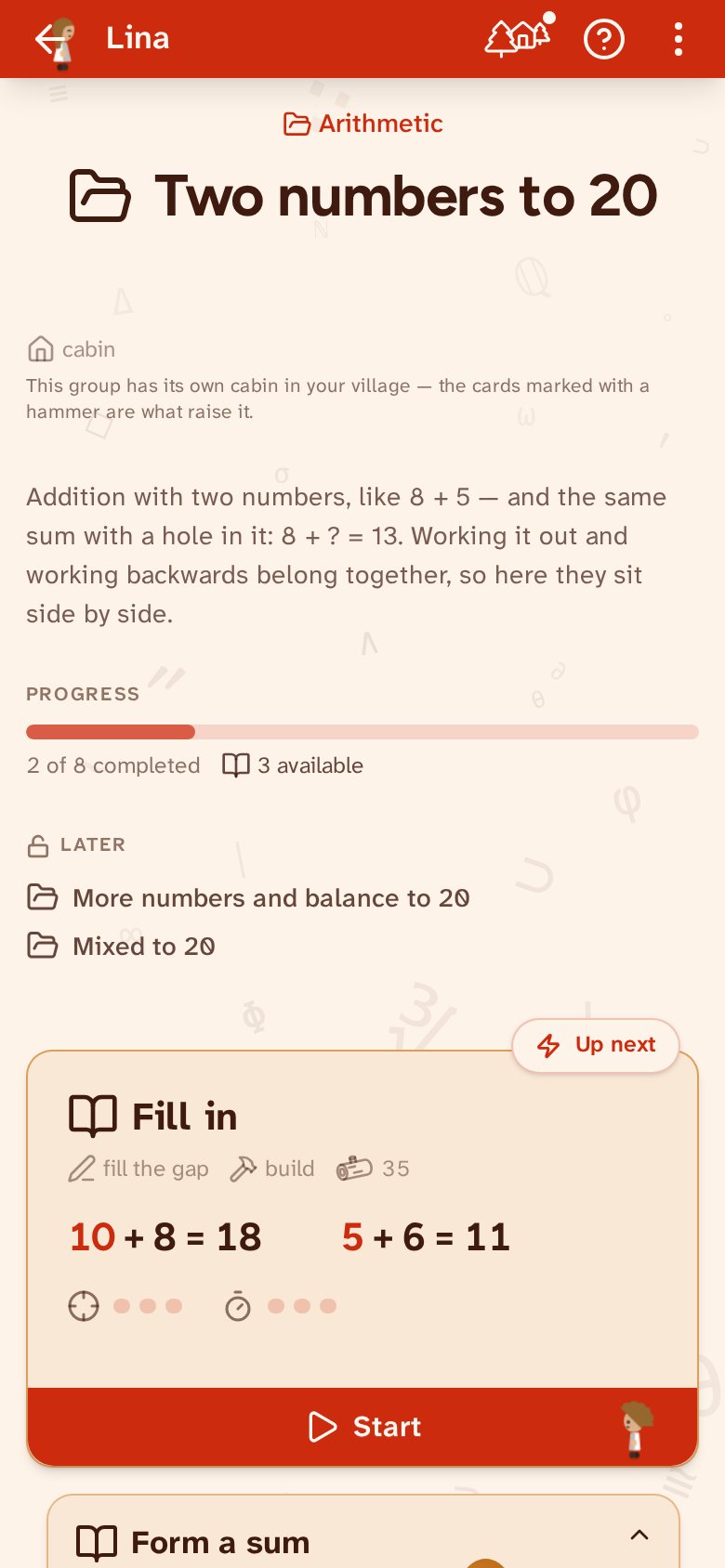
1
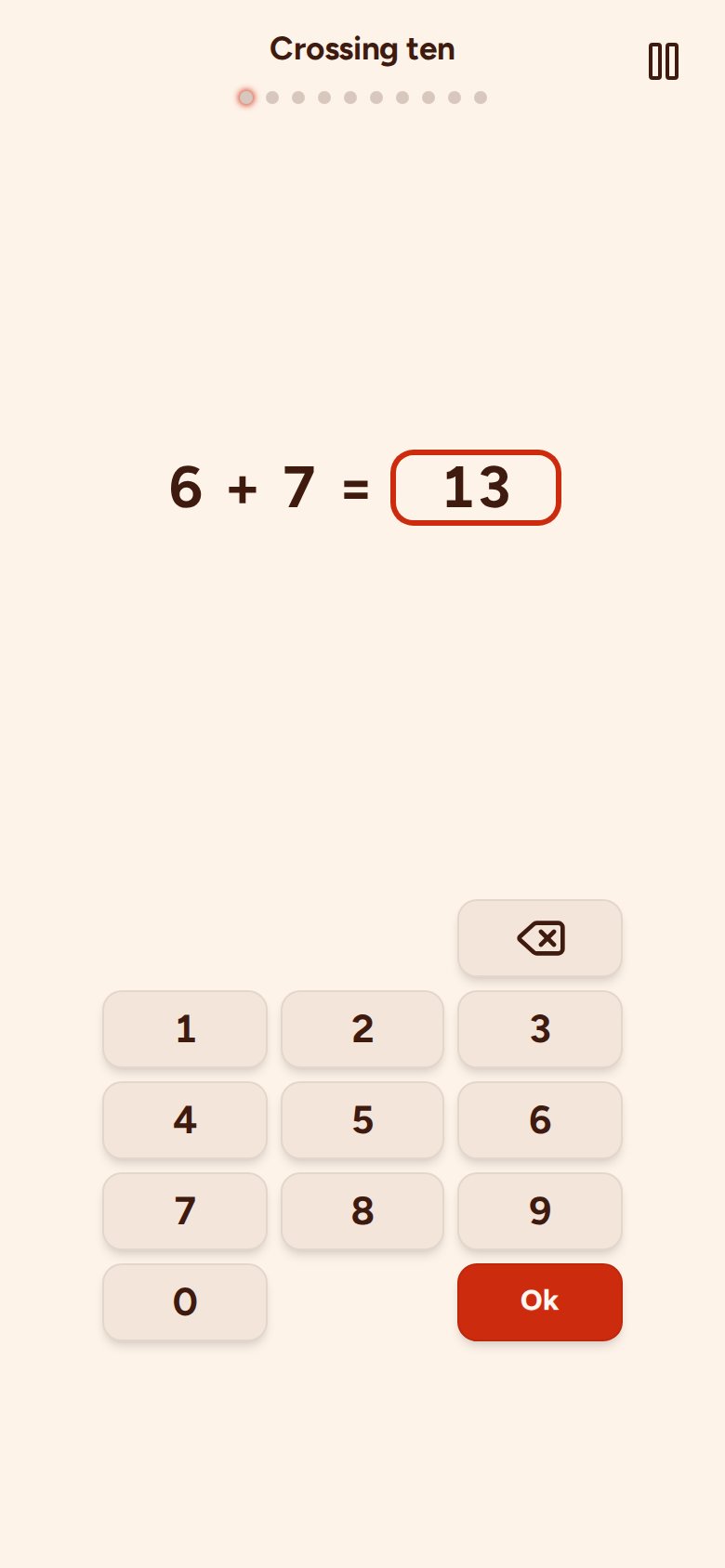
2
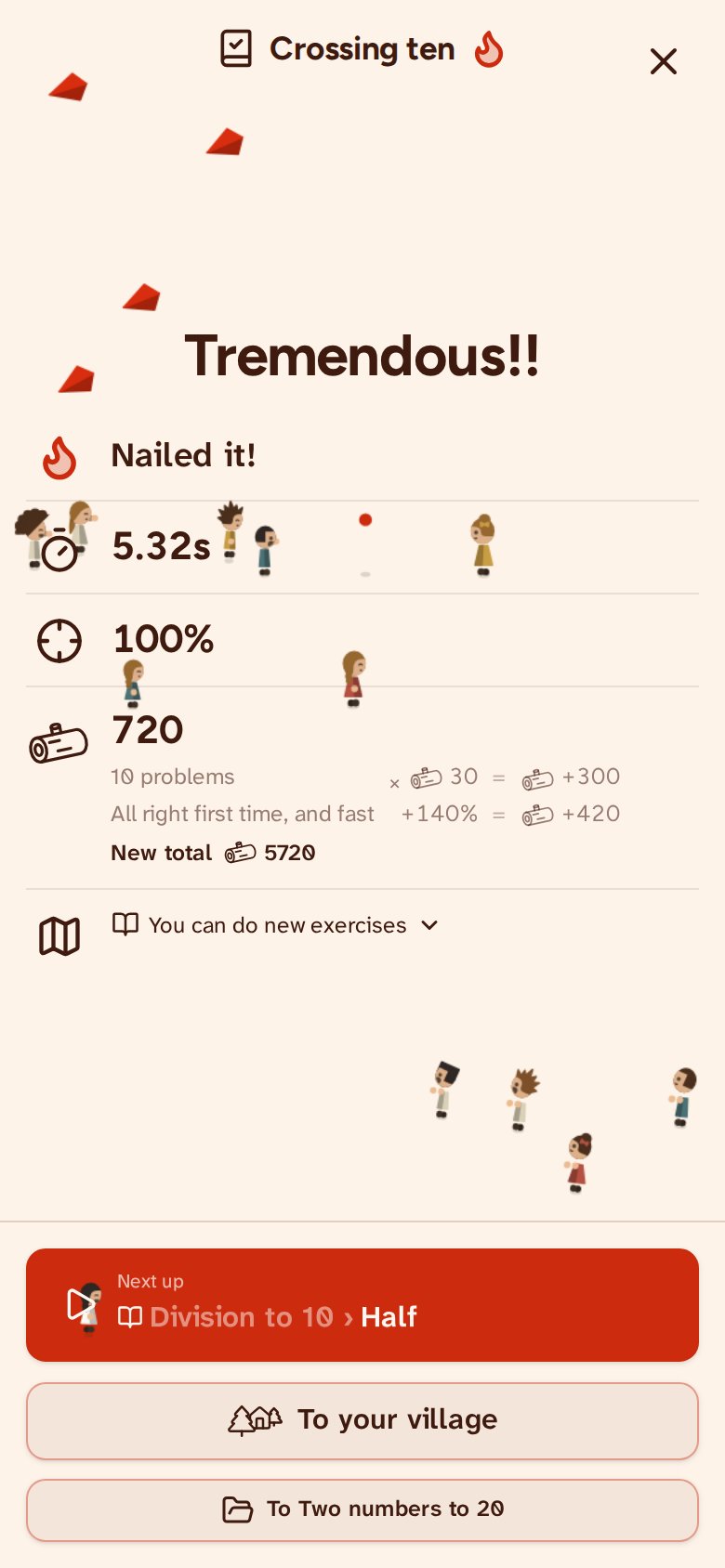
3
4
How it fits together
The arrows point to what can be done next. Whatever sits inside a box belongs to it.
Needed first
Addition
Addition to 20
Two numbers to 20
More numbers and balance to 20
All together
Can come next
first this, then that belongs to
Two numbers to 20
Choose two numbers that make the total together
12 + 5: just add the ones, 2 + 5 = 7, so 17.
Fill up to ten first: 8 + 5 = 8 + 2 + 3 = 13.
Turn it round: ? + 5 = 17 is the same as 17 − 5.
Jump to the next ten first: ? + 6 = 20 — from 6 to 10 is 4, then 10 more, so 14.
Turn it round: ? + 5 = 13 is the same as 13 − 5.
Look first: do the ones add up past ten?
More numbers and balance to 20
Look for numbers that make a round number together first, like 7 + 3.
Work out one side, then make the other side the same.
Work out what is already there first, then see how much is missing.
Against the clock: how many can your child do in sixty seconds?
Look for numbers that make a round number together first, like 7 + 3.
Against the clock: how many can your child do in sixty seconds?
Work out what is already there first, then see how much is missing.
Mixed to 20
The same sum as 8 + 5 = 13, but ten times bigger: 80 + 50 = 130.
Against the clock: how many can your child do in sixty seconds?
The same sum as 8 + 5 = 13, but a hundred times bigger: 800 + 500 = 1300.
Just like 6 + 14 = 20, but ten times bigger: 60 + 140 = 200.
The same sum as 8 + 5 = 13, but a thousand times bigger: 8000 + 5000 = 13000.
Just like 6 + 14 = 20, but a hundred times bigger: 600 + 1400 = 2000.
Just like 6 + 14 = 20, but a thousand times bigger: 6000 + 14000 = 20000.
All together
Everything in this topic in one round of 60 sums.
- Plus and minus — on the Subtraction to 20 page
- Plus and minus: fill in — on the Subtraction to 20 page
- Plus and minus: big round — on the Subtraction to 20 page
- Quick: plus and minus — on the Subtraction to 20 page
- Plus and minus: three numbers — on the Subtraction to 20 page
- Plus and minus: balance — on the Subtraction to 20 page
Why it matters
Adding to 20 is all about one moment: crossing ten. In 14 + 3 everything stays within the same ten; in 9 + 4 your child has to go over it. A child who understands that moment has grasped the most important idea in our number system: ten ones together make one ten.
That is why this step keeps the two kinds of sum apart at first and then mixes them. Your child learns not only to work them out, but also to predict what is going to happen. That prediction comes back in every addition with bigger numbers, well beyond 100.
How to approach it
An egg box with ten spaces is a good picture. For 7 + 6, after the seven there are three spaces left; fill those first, and there are three left over for a new box. One full box and three extra: 13. Your child can literally see what ‘crossing ten’ means.
A second handhold is doubles: 6 + 6, 7 + 7, 8 + 8. If your child knows those, 7 + 8 is simply ‘seven add seven, and one more’. Let your child find out which route they prefer; both are fine, as long as they no longer need to count on their fingers.
When is it secure?
A round of 10 sums in one go without a mistake, within 35 seconds. That is about 3.5 seconds a sum: no more counting, just knowing.