Choose two numbers that make the total together
Addition to 30
Adding to 30 practice, from 25 + 1 to 18 + 12 = 30: crossing the second ten, then three or four numbers and balance sums, then everything mixed.
Your child can only do the exercises here once they can add and subtract within 20, crossing ten included. This is where you find out whether crossing ten was really understood: in 19 + 3 the sum goes past 20, and a child who learnt the trick only for 10 gets stuck at once.
Usually taught in Year 2 in England and Wales, around ages 6 to 7. Every child goes at their own pace; this is a guide, not a requirement.
The first of 22 exercises in this topic. See them all
What it looks like for your child
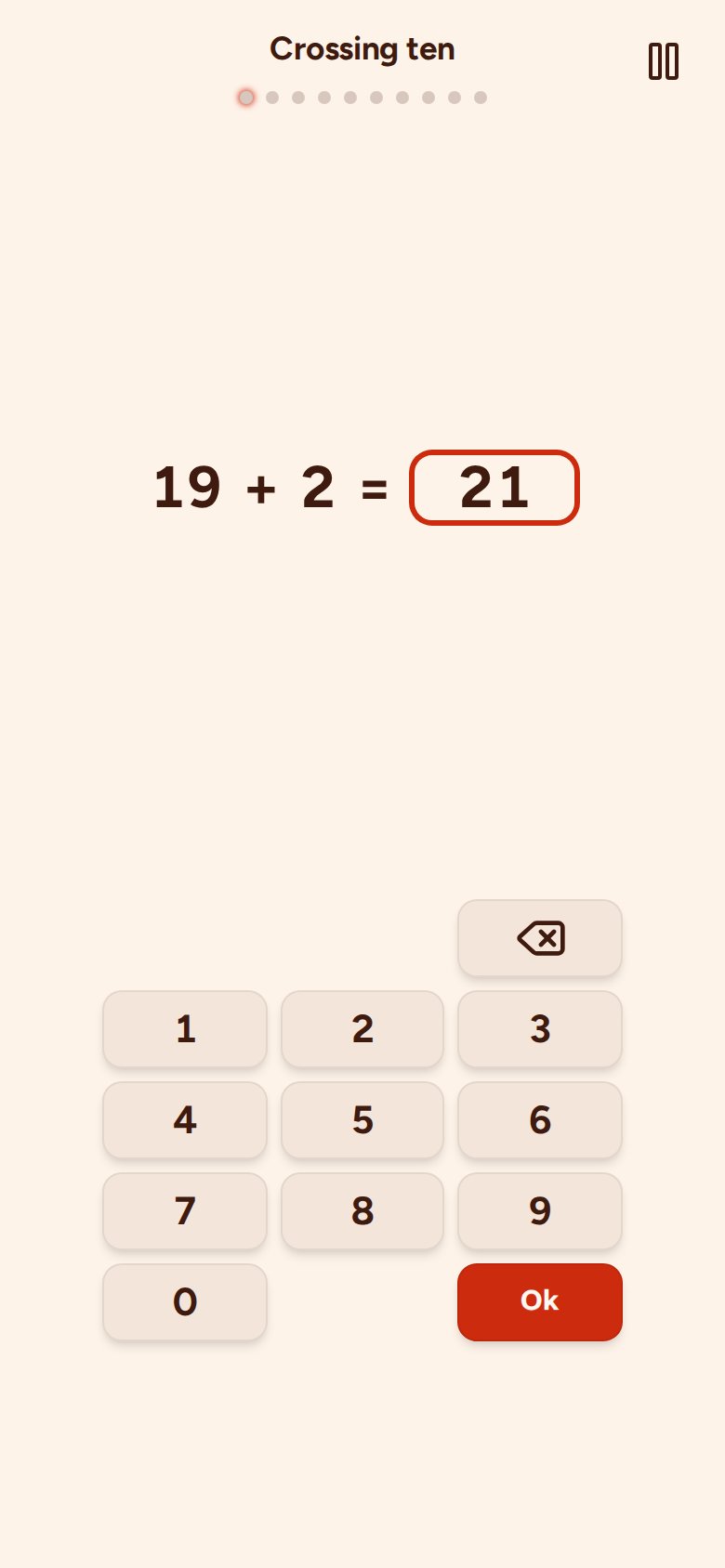
With one exercise from this topic as the example: Crossing ten.
1
2
3
4
How it fits together
The arrows point to what can be done next. Whatever sits inside a box belongs to it.
Needed first
Addition
Addition to 30
Two numbers to 30
More numbers and balance to 30
All together
Can come next
first this, then that belongs to
Two numbers to 30
21 + 6: just add the ones, 1 + 6 = 7, so 27.
Jump to the next ten first: 17 + 5 = 17 + 3 + 2 = 22.
Turn it round: ? + 6 = 27 is the same as 27 − 6.
How much is missing up to 30? ? + 22 = 30: from 22 to 30 is 8.
Turn it round: ? + 5 = 22 is the same as 22 − 5.
Look first: do the ones add up past ten?
More numbers and balance to 30
Look for numbers that make a round number together first, like 7 + 3.
Work out one side, then make the other side the same.
Work out what is already there first, then see how much is missing.
Against the clock: how many can your child do in sixty seconds?
Look for numbers that make a round number together first, like 7 + 3.
One minute, as many sums as possible. Not needed to move on, but good for getting quicker.
Work out what is already there first, then see how much is missing.
Mixed to 30
The same sum as 17 + 5 = 22, but ten times bigger: 170 + 50 = 220.
A race against time, for children who can already do it and want to be faster.
The same sum as 17 + 5 = 22, but a hundred times bigger: 1700 + 500 = 2200.
Just like 12 + 18 = 30, but ten times bigger: 120 + 180 = 300.
The same sum as 17 + 5 = 22, but a thousand times bigger: 17000 + 5000 = 22000.
Just like 12 + 18 = 30, but a hundred times bigger: 1200 + 1800 = 3000.
Just like 12 + 18 = 30, but a thousand times bigger: 12000 + 18000 = 30000.
All together
Everything in this topic in one round of 50 sums.
- Plus and minus — on the Subtraction to 30 page
- Plus and minus: fill in — on the Subtraction to 30 page
- Plus and minus: three numbers — on the Subtraction to 30 page
- Plus and minus: balance — on the Subtraction to 30 page
- Plus and minus: big round — on the Subtraction to 30 page
- Quick: plus and minus — on the Subtraction to 30 page
Why it matters
After 20 you find out whether crossing ten has really been understood. In 18 + 7 the sum goes past 20 rather than 10, and a child who learnt the trick only for ten notices straight away. The aim of this step is for the method to work with any ten, not just one particular number.
The bigger sums with hundreds and thousands rely on this too. 180 + 70 is nothing more than 18 + 7 with a zero on the end. Each step builds a little further, without a lot of new things arriving at once.
How to approach it
A number line on paper helps a lot here. Draw a line with 10, 20 and 30 on it, and for 16 + 8 let your child draw the jumps: from 16 to 20 is 4, then 4 more, so 24. A child who sees the jumps remembers them better than one who only hears them.
Now and then, ask your child to estimate before working it out: will it be more or less than 20? With 13 + 9 you know at once it will be over 20, so an answer like 12 stands out as wrong. That short moment of estimating catches a lot of careless mistakes.
When is it secure?
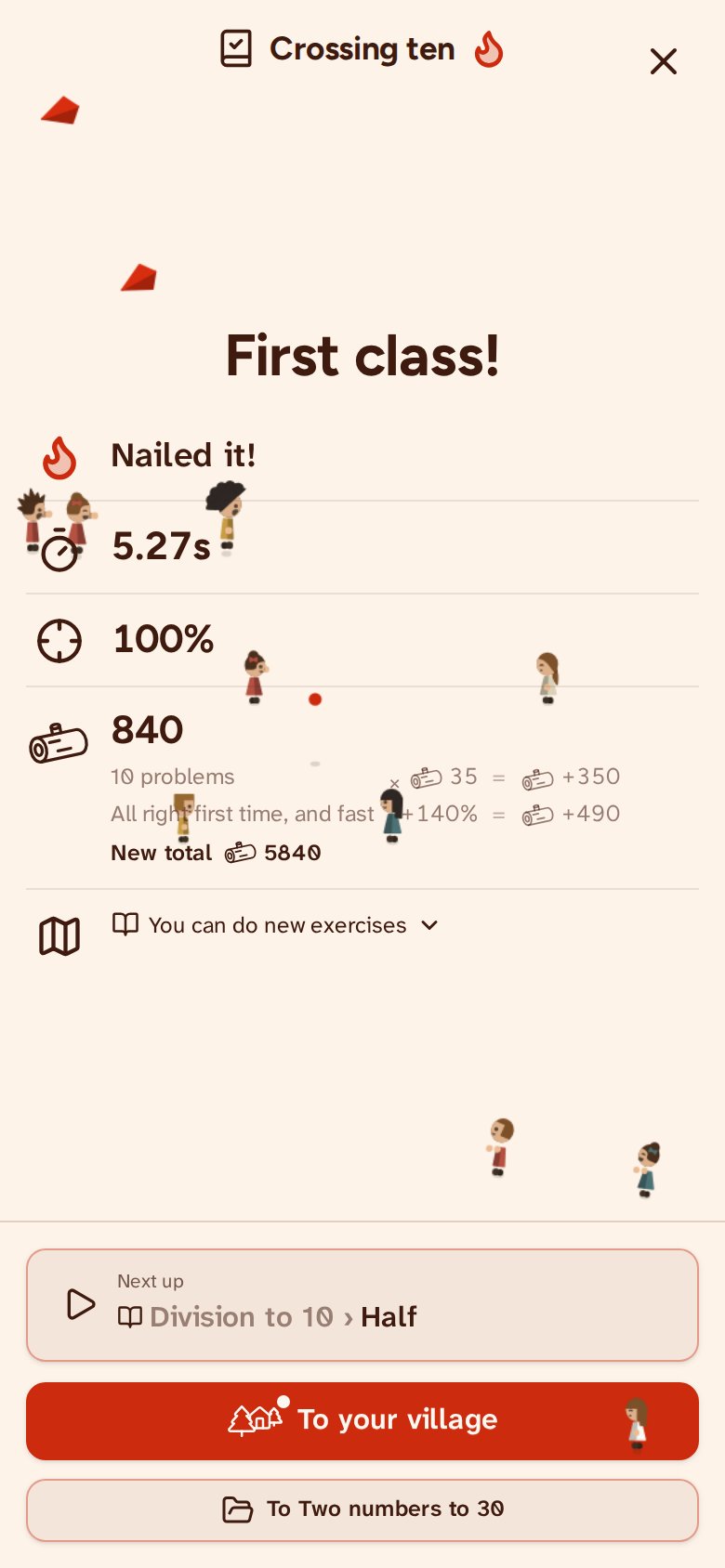
When your child gets all 10 sums right in 40 seconds or less. Answers only come that quickly once they come from memory.