Two fractions. Is the number under the line the same? Yes or no.
Adding fractions
Adding fractions practice, from 5/11 + 4/11 to 1/3 + 3/4 = 4/12 + 9/12: the same denominator first, then different ones, then finishing off the answer.
Your child can start here once they can read fractions; the later exercises, with different denominators, also need equivalent fractions and the times tables. A sixth and a quarter can only be added once both are in twelfths: finding the 12 is the tables, and rewriting 1/6 as 2/12 is equivalent fractions.
Usually taught in Year 4–5 in England and Wales, around ages 8 to 10. Every child goes at their own pace; this is a guide, not a requirement.
The first of 14 exercises in this topic. See them all
What it looks like for your child
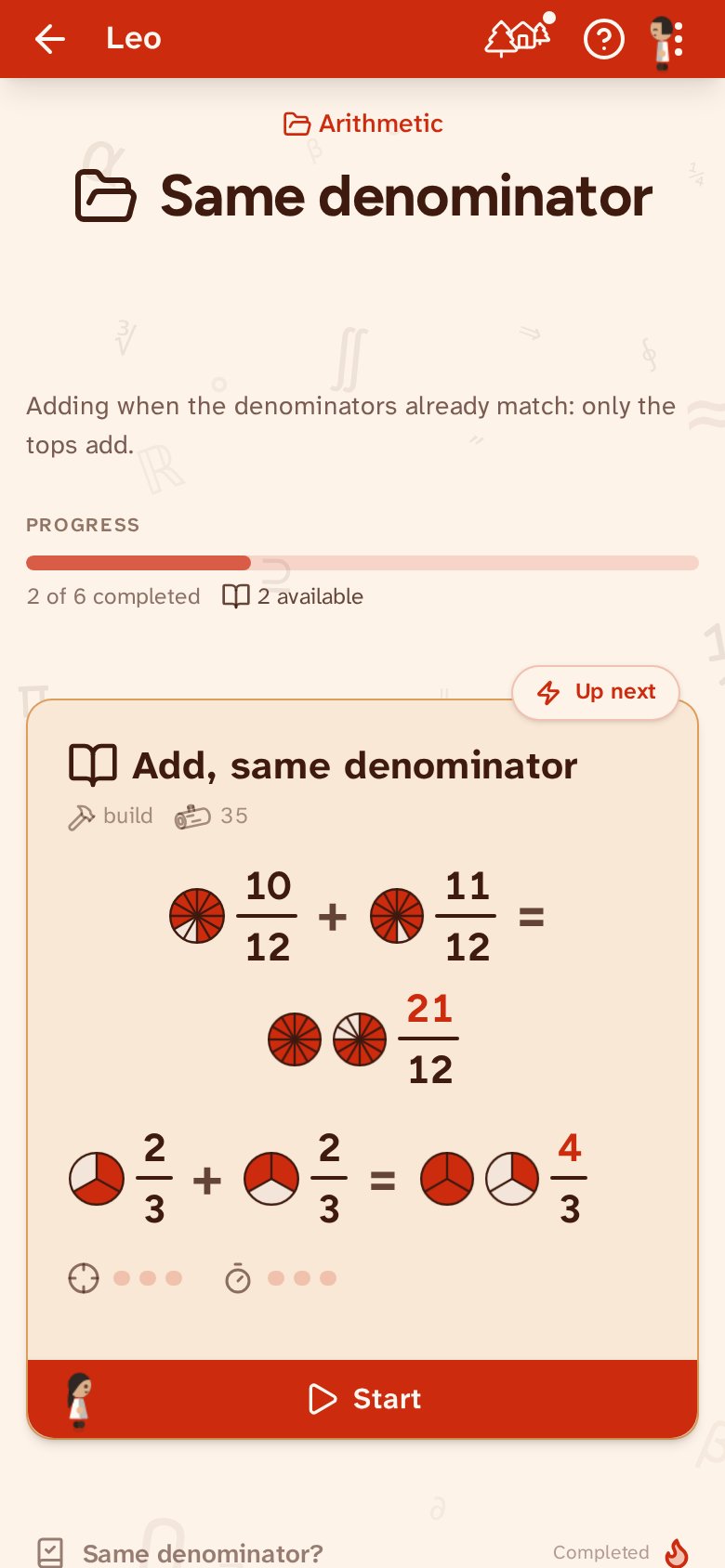
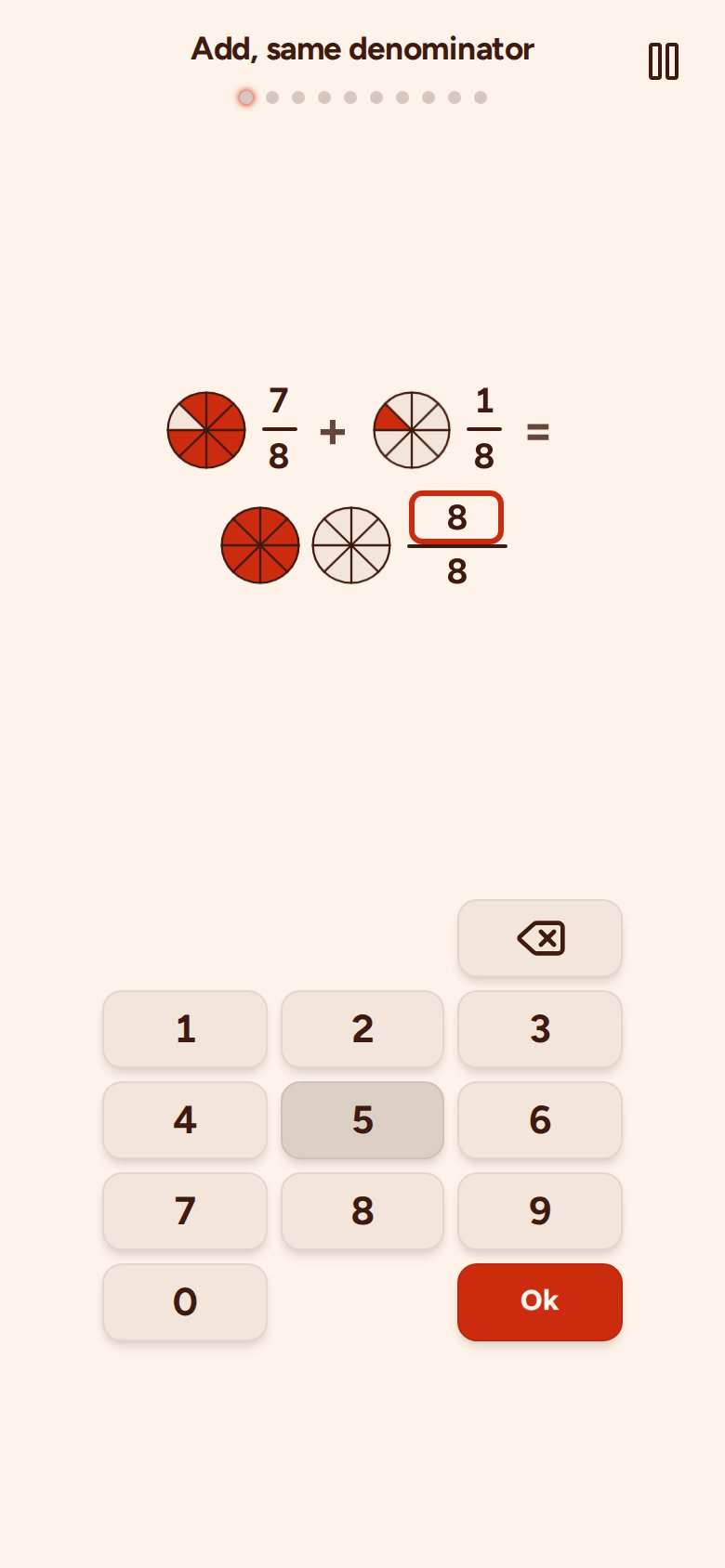
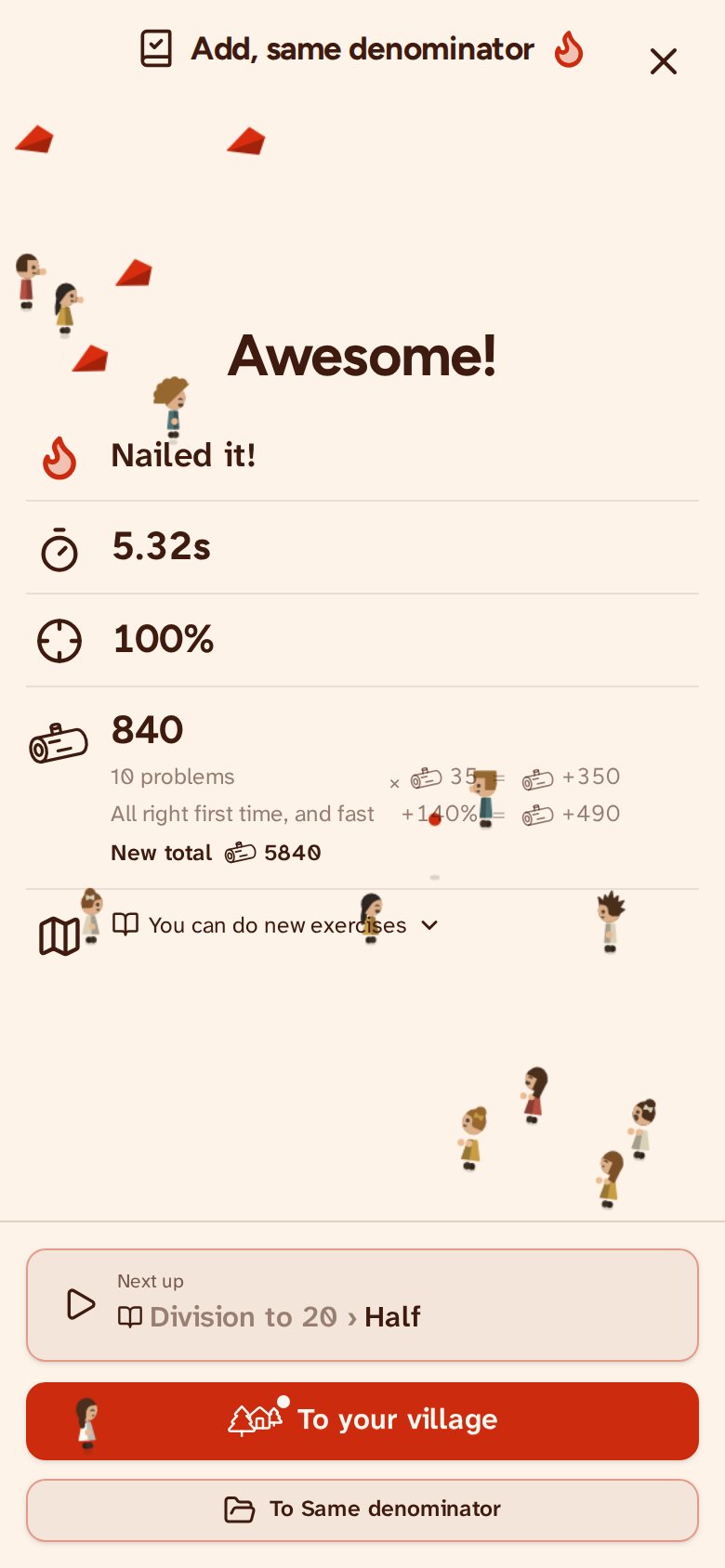
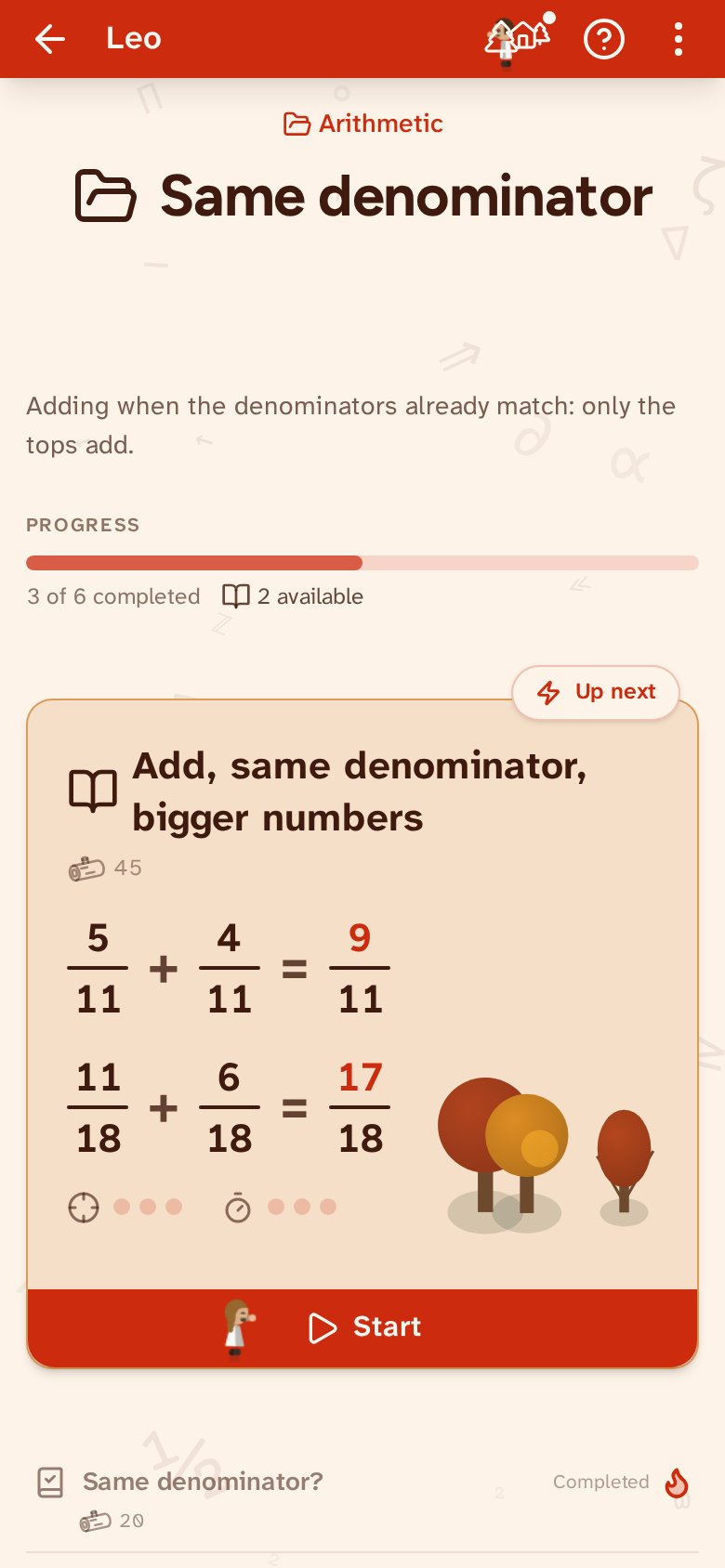
With one exercise from this topic as the example: Add, same denominator.
1
2
3
4
How it fits together
The arrows point to what can be done next. Whatever sits inside a box belongs to it.
Needed first
Fractions
Adding fractions
Same denominator
Different denominators
Can come next
first this, then that belongs to
Same denominator
Pick every fraction with the same number under the line as the one above. Not the same amount — the same denominator.
1/5 + 2/5 = ?/5. The denominators are the same, so only the tops add. Together they can come to more than one whole.
5/11 + 4/11 = ?/11. The denominators are the same, so only the tops add.
3 5/17 + 2 1/17 = ? ?/17. The whole ones add together, and so do the numerators.
Different denominators
1/3 + 1/4 = ?/12 + ?/12. Write both with the same denominator, and then they can be added.
1/3 + 1/4 = ?/12. Both over the same denominator, and then the numerators add.
2/3 + 1/4 = ?/12 + ?/12. The numerator is not always 1 now: times as many as you have.
2/3 + 1/4 = ?/12. Together they can now come to more than one whole.
1/4 + 7/10 = ?/20. Both over the same denominator first, then the numerators add.
Finishing the answer
1/6 + 1/3 = ?/?. Add them, and write the answer in the smallest numbers.
1 5/6 + 2/3 = ? ?/?. Add them, write it as small as it goes, and take out the whole pies.
11/12 + 5/6 = ?/?. Add them, and write the answer in the smallest numbers.
1/2 + 3 15/16 = ? ?/?. All of it at once: add, make it as small as it goes, take out the whole ones.
Why it matters
Adding fractions shows whether a child understands what a fraction is. A child who works out 1/3 + 1/3 as 2/6 adds the slices together but forgets that they stay the same size. Two thirds of a cake is simply two slices of the same size.
With different denominators, everything practised earlier comes together. You can only add a sixth and a quarter once you write them in the same size of slice, and that is exactly what equivalent fractions teach you.
How to approach it
The exercises build it up in three steps. First the same denominator: only the numerators are added, the denominator stays as it is. Then different denominators: find a denominator that suits both, for 1/6 and 1/4 that could be 12, and write them as 2/12 and 3/12.
Finally, finishing off the answer. 6/8 becomes 3/4, and 7/5 becomes 1 2/5. Don't let your child skip that last step: it is exactly the habit that saves the most work later, with bigger numbers.
When is it secure?
A round of 10 sums in one go without a mistake, within 20 seconds. That is about 2 seconds a sum: no more counting, just knowing.