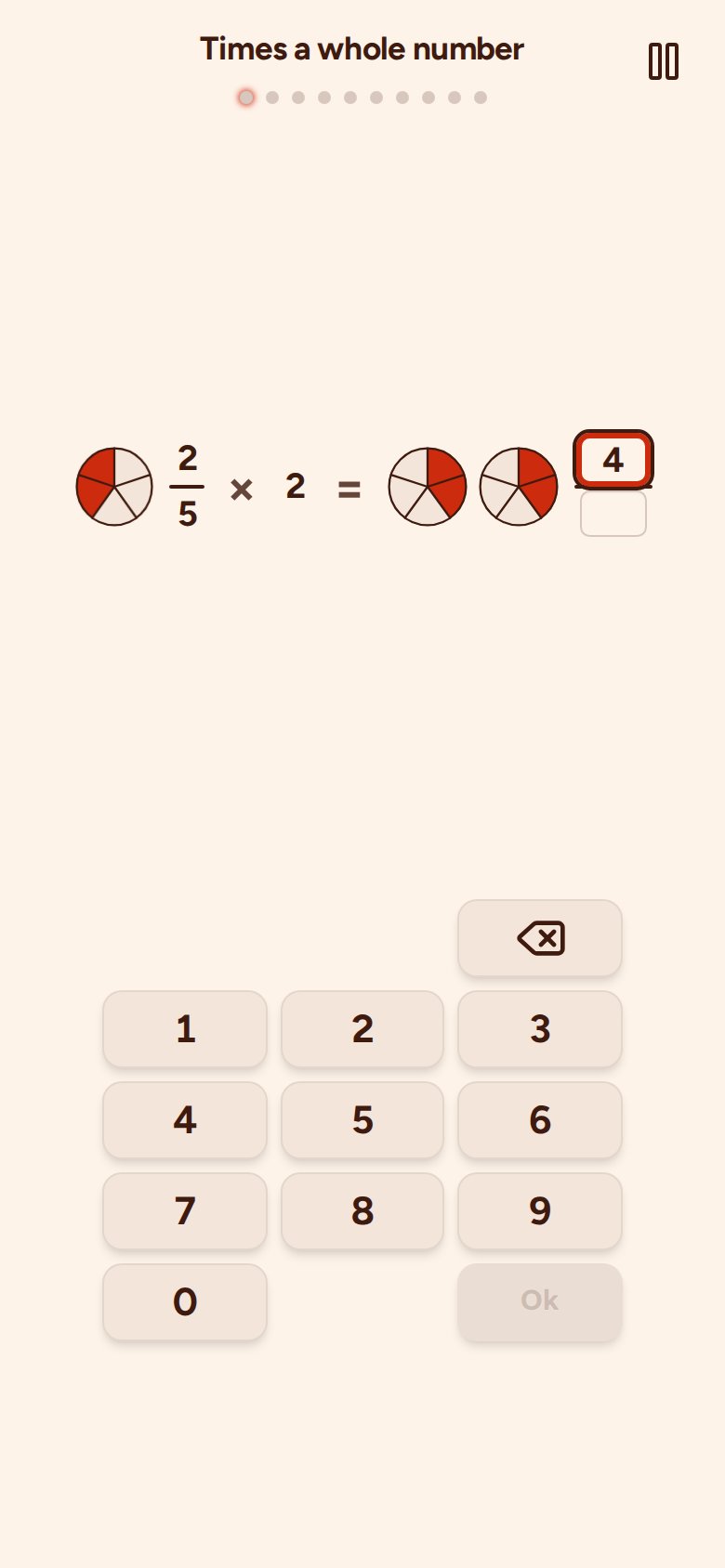
The same pie a few times over. Which picture shows the same amount, filled up pie by pie?
Multiplying and dividing fractions
Practise multiplying and dividing fractions, from 2/9 × 4 to 3/4 ÷ 2/5: first by a whole number, then by a fraction, each step once the last one sticks.
Your child can start here once they can read fractions; the later exercises also need adding fractions, equivalent fractions, the times tables and multiplication and division up to 20. That is no formality: a child who multiplies fractions without a firm grip on equivalent fractions gets stuck when simplifying.
Usually taught in Year 5–6 in England and Wales, around ages 9 to 11. Every child goes at their own pace; this is a guide, not a requirement.
The first of 12 exercises in this topic. See them all
What it looks like for your child
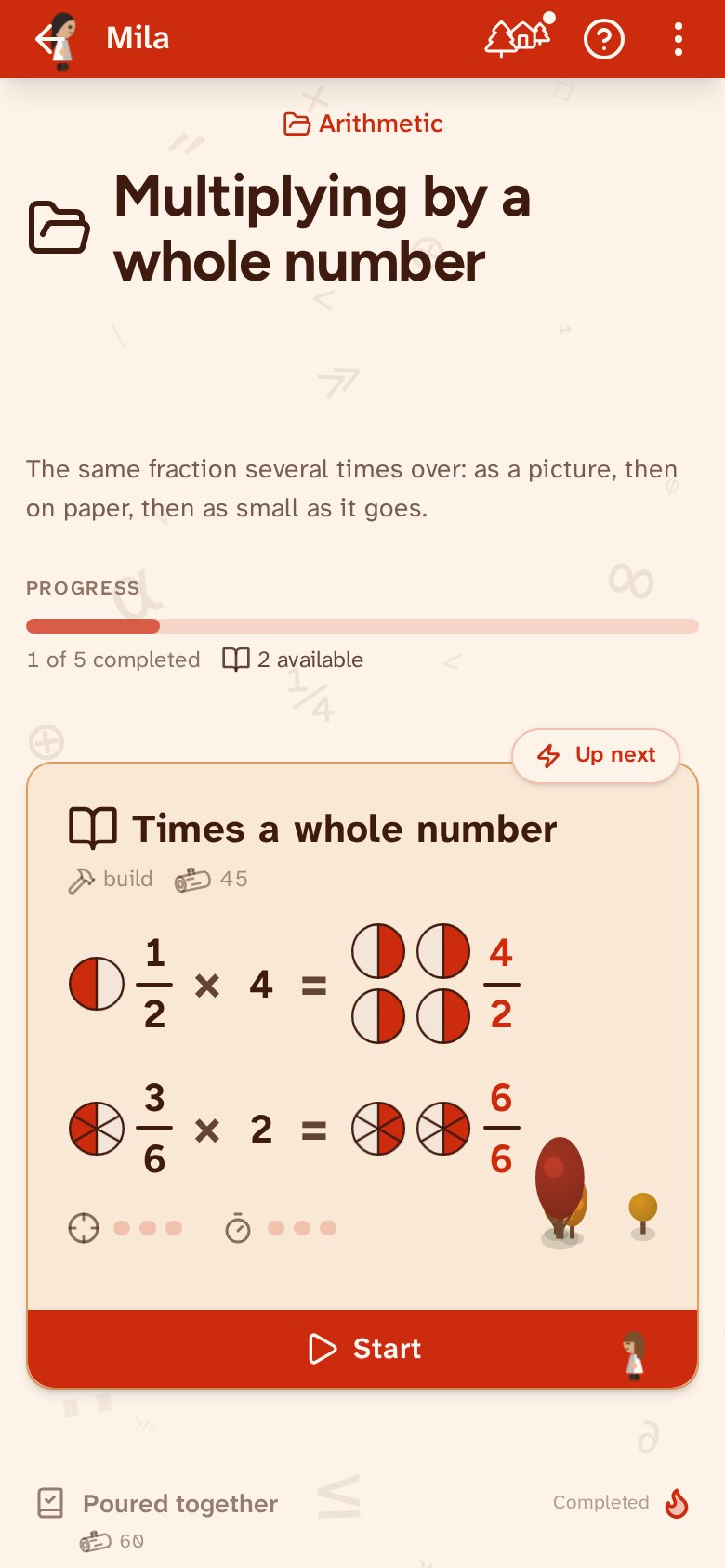
With one exercise from this topic as the example: Times a whole number.
1
2
3
4
How it fits together
The arrows point to what can be done next. Whatever sits inside a box belongs to it.
Needed first
Fractions
Multiplying and dividing fractions
Multiplying by a whole number
Dividing by a whole number
Multiplying and dividing by a fraction
Can come next
first this, then that belongs to
Multiplying by a whole number
3/8 × 3 = ?/?. The top is taken three times, the bottom stays.
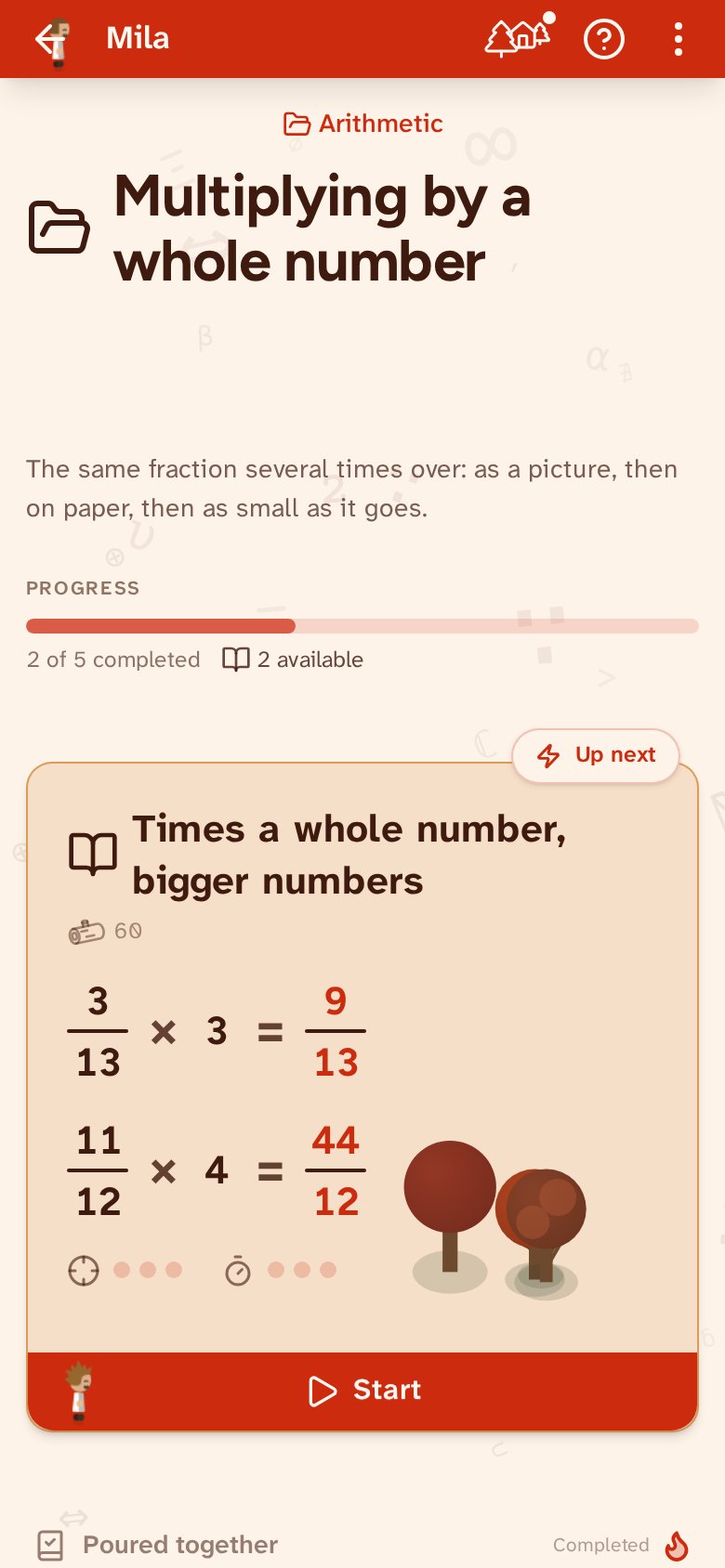
11/12 × 4 = ?/12. The top is taken four times, the bottom stays.
3/8 × 4 = ?/?. The top is taken four times, and then you write it in the smallest numbers.
Dividing by a whole number
6/8 ÷ 2 = ?/?. The slices are shared out evenly; the bottom stays where it is.
The same division without the picture, and with bigger numbers — bottoms up to twenty.
3/8 ÷ 2 = ?/?. The top will not share out, so the pieces themselves get smaller.
3/4 ÷ 3 = ?/?. The bottom times the divisor first, and then the answer in the smallest numbers it can take.
Multiplying and dividing by a fraction
2/3 × 1/4 = ?/?. Tops times tops, bottoms times bottoms.
2/3 ÷ 1/4 = ?/?. Turn the second one over and multiply — the answer can be bigger than what you started with.
2/3 × 3/4 = ?/?. Multiply them, then write it in the smallest numbers.
2/3 ÷ 4/9 = ?/?. The same division, and then the answer in the smallest numbers it can take.
Why it matters
Multiplying by a fraction feels contradictory at first. With whole numbers the answer gets bigger, but 1/2 × 3/5 is less than 3/5. And dividing by a fraction gives you more: four halves fit into 2. Those surprises are exactly the reason to practise this calmly.
A child who is confident here is in a strong position for ratio, percentages and scale, where the same operations come back in different clothes.
How to approach it
Start with a whole number. 2/9 × 4 is four lots of two ninths: the numerator becomes 8, the denominator stays 9. Dividing by a whole number goes the other way: the cake is shared out fairly, and if the numerator won't divide, the slices get smaller.
With two fractions the rule is short: multiply the numerators, multiply the denominators. To divide, turn the second fraction upside down and multiply. With every answer, ask your child whether it should have got bigger or smaller; that check catches a lot of careless slips.
When is it secure?
A round of 10 sums in one go without a mistake, within 60 seconds. That is about 6 seconds a sum: no more counting, just knowing.