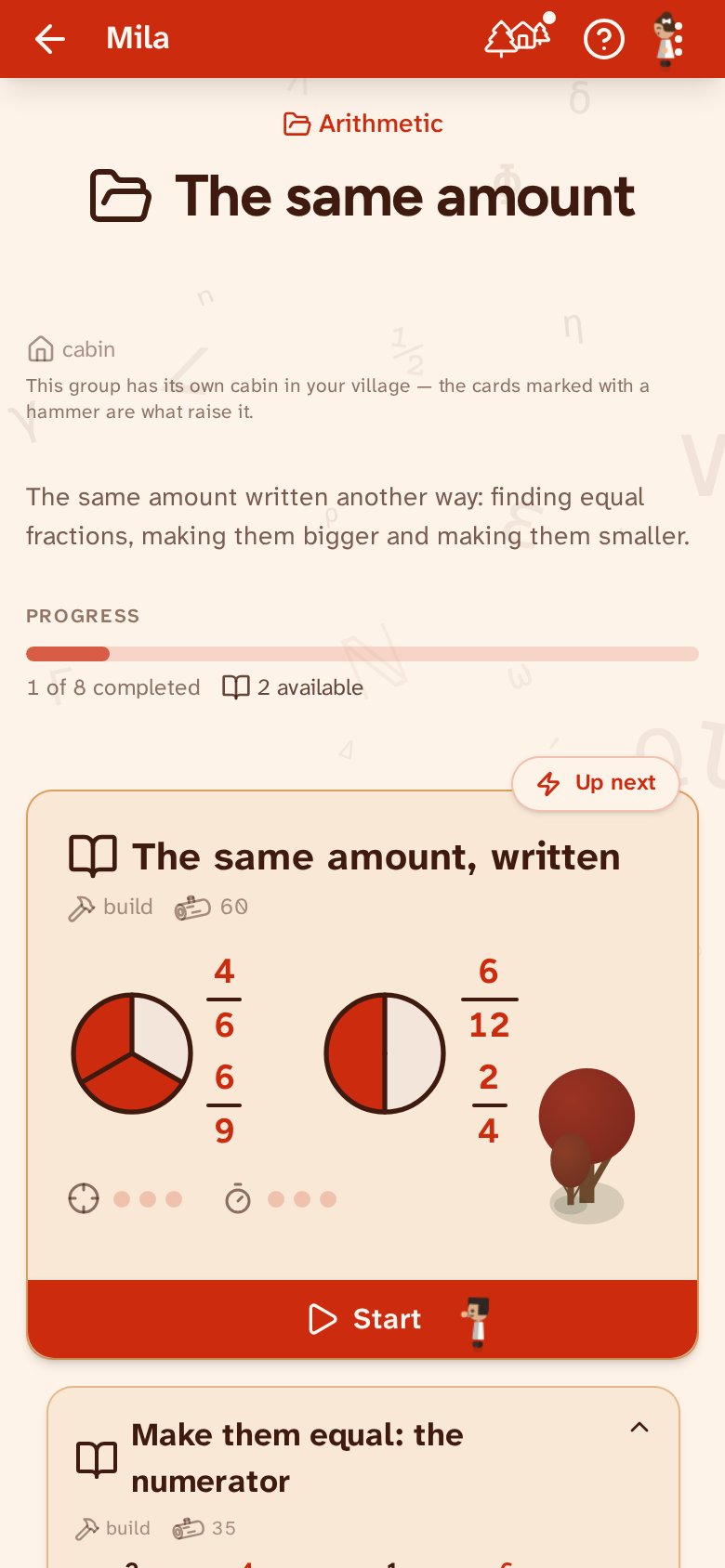
Pick every pie with just as much shaded as the one shown. There are between one and three.
Equivalent fractions
Equivalent fractions practice, from 2/6 = 1/3 to 10/15 = 2/3: first seeing the same amount, then matching the numerator or denominator, then simplifying.
Your child can start here once they can read fractions; the later exercises also need multiplication up to 20 and the times tables. Turning 2/3 into 10/15 means multiplying top and bottom by 5, and simplifying 12/16 means spotting that 4 goes into both, which is the tables at work.
Usually taught in Year 3–4 in England and Wales, around ages 7 to 9. Every child goes at their own pace; this is a guide, not a requirement.
The first of 8 exercises in this topic. See them all
What it looks like for your child
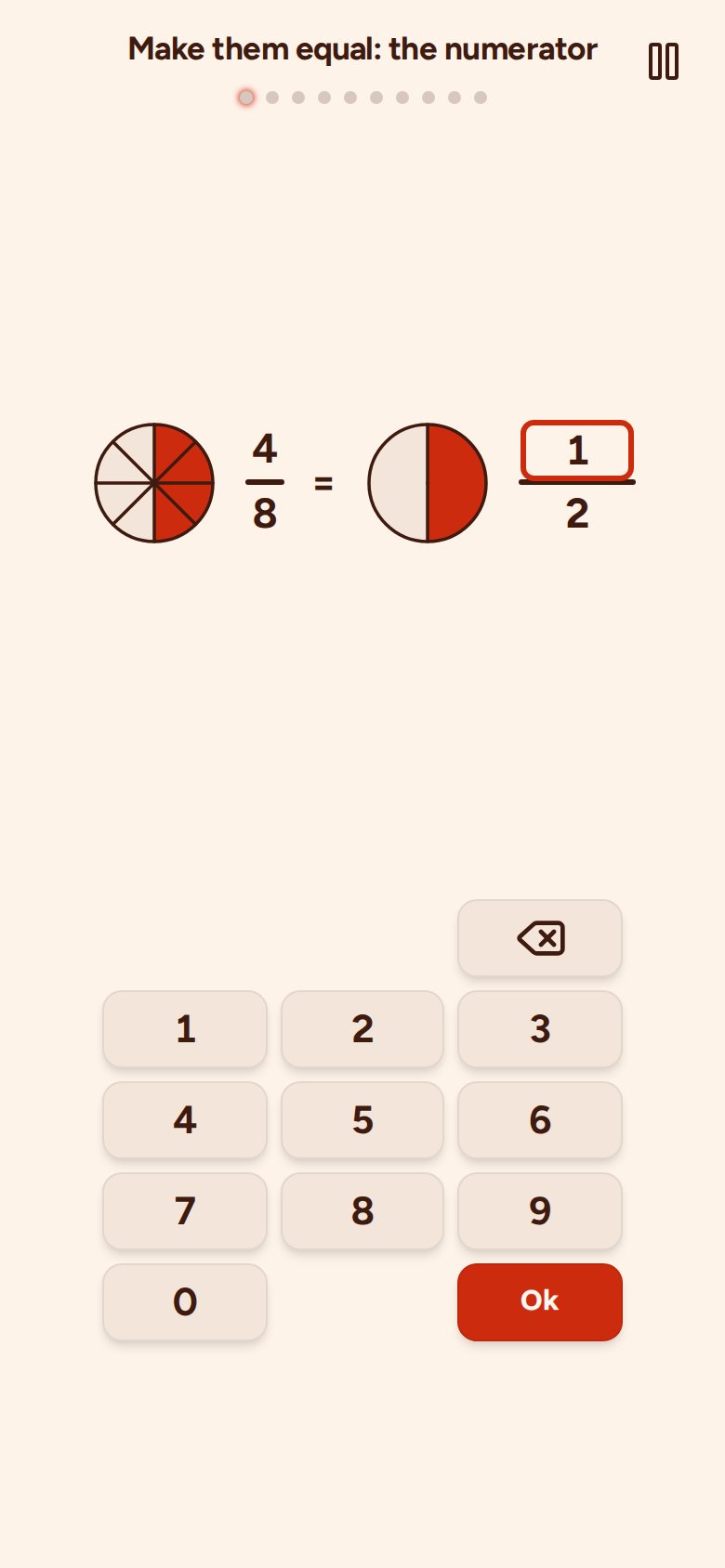
With one exercise from this topic as the example: Make them equal: the numerator.
1
2
3
4
How it fits together
The arrows point to what can be done next. Whatever sits inside a box belongs to it.
Needed first
Fractions
Can come next
first this, then that belongs to
Pick every fraction worth the same as the pie. There may be one, two or three.
2/3 = ?/12, or 8/12 = ?/3. The denominator was multiplied or divided to get there; do the same to the numerator.
2/3 = 8/?, or 8/12 = 2/?. The numerator was multiplied or divided to get there; do the same to the denominator.
A pie, and fractions to choose from. Can it be written with smaller numbers, or not?
More than one pie, in small pieces. Which picture shows the same amount, in bigger pieces?
5/6 = ?/18. The denominator was multiplied to get there; do the same to the numerator.
5/6 = 15/?. The numerator was multiplied to get there; do the same to the denominator.
Why it matters
That two different fractions can be exactly the same amount surprises many children. Yet it is the basis of almost all the fraction work that follows: adding with different denominators and simplifying an answer both depend on it.
A child who understands why 3/4 and 9/12 are equal doesn't need to cram rules. They are the same slices of cake, only each slice has been cut into three again.
How to approach it
Start with the pictures: which cake has the same amount coloured, even though the slices are different? Then comes the rule that goes with it: whatever you do to the denominator, you do to the numerator too. If the denominator becomes five times as big, so does the numerator: 2/3 = 10/15.
The other way works just the same, but with division. 12/16 can be simplified, because 12 and 16 can both be divided by 4: 3/4. With every fraction, ask your child: can this one be written with smaller numbers?
When is it secure?
All 10 right in one round, and no more than 60 seconds altogether. Around 6 seconds a sum shows your child is no longer counting.