Dividing by 2: half of 32 to 50.
Division to 50
Division to 50 practice, from 36 ÷ 4 to 48 ÷ 2 = 24 and 4200 ÷ 600 = 7: halving up to 50, the bigger division facts, and a round mixing times and divide.
Your child can start here once they can divide up to 30 and multiply up to 50; the later exercises also lean on multiplication up to 30. Division facts like 42 ÷ 6 and 48 ÷ 8 are the bigger tables read backwards, and practising them before 6 × 7 and 6 × 8 are known would only mean meeting the same gap twice.
Usually taught in Year 3–4 in England and Wales, around ages 7 to 9. Every child goes at their own pace; this is a guide, not a requirement.
The first of 11 exercises in this topic. See them all
What it looks like for your child
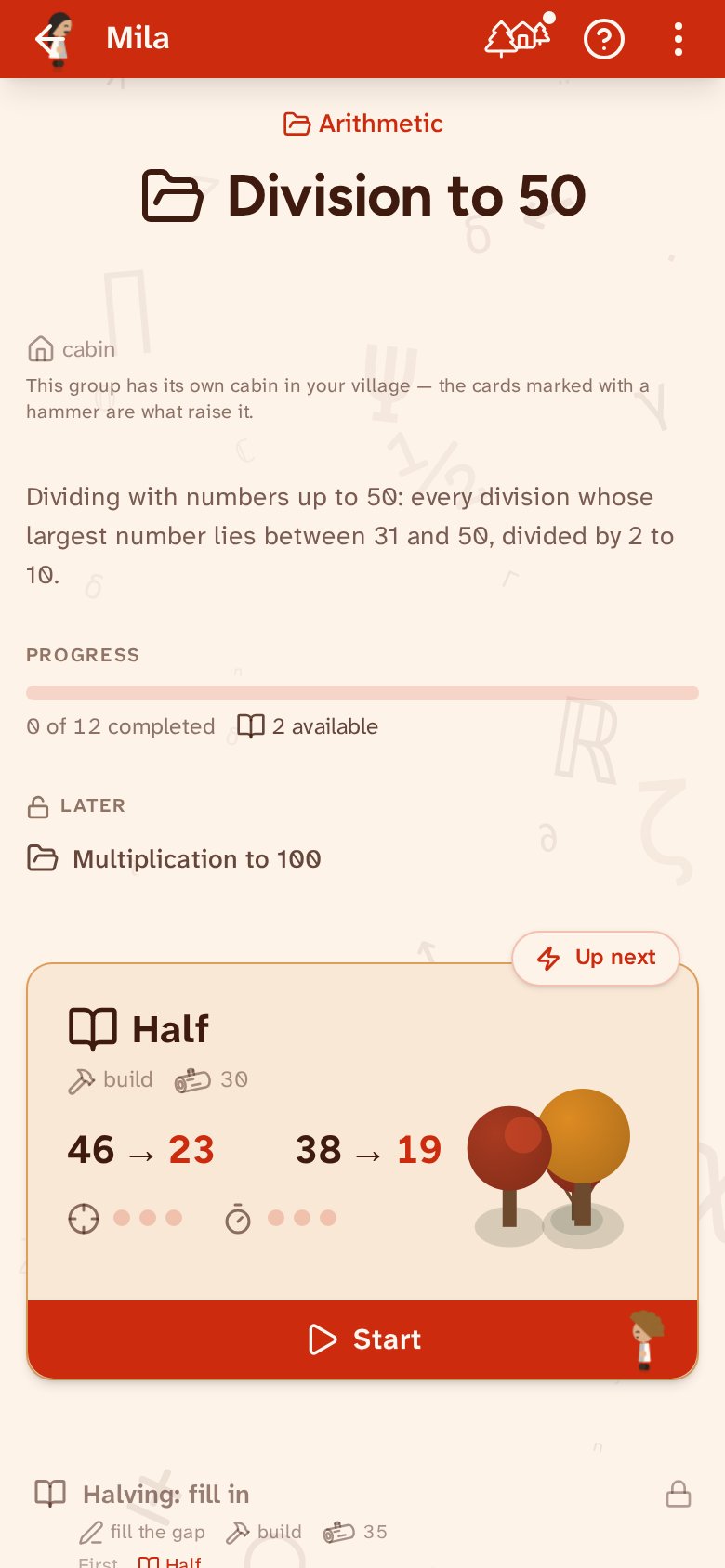
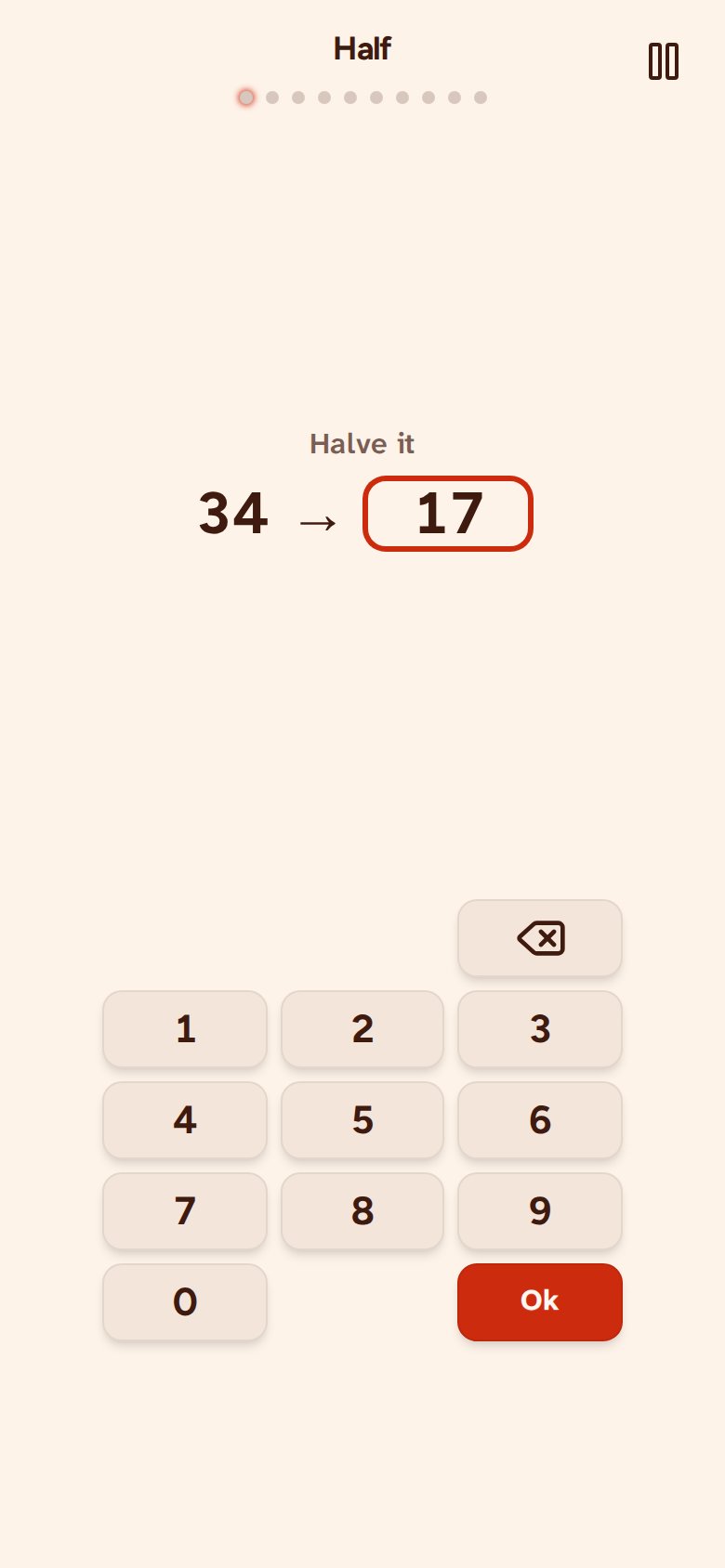
With one exercise from this topic as the example: Half.
1
2
3
4
How it fits together
The arrows point to what can be done next. Whatever sits inside a box belongs to it.
Division
Division to 50
Can come next
first this, then that belongs to
Halving backwards is doubling: ? → 23, so 23 + 23.
Dividing is the table backwards: 36 ÷ 4 — what times 4 makes 36?
The same sums, but a different number missing each time: the answer, the divisor, or the number being divided.
A race against time, for children who can already do it and want to be faster.
Dividing is the table backwards: 36 ÷ 4 — what times 4 makes 36?
The same sums to 50, with zeros on the end: if you know 8 ÷ 2 = 4, you also know 80 ÷ 20 = 4, 800 ÷ 200 = 4 and 800 ÷ 2 = 400.
Which two numbers give this result? Tap them in the right order.
30 sums in a row, everything mixed: the real test.
One minute, as many sums as possible. Not needed to move on, but good for getting quicker.
30 sums in a row, everything mixed: the real test.
Why it matters
At this step the bigger times tables facts get their division partners: 42 ÷ 6, 48 ÷ 8, 45 ÷ 5. These are exactly the facts that stay shaky longest in multiplication, so practising them from both sides helps twice over.
In the round mixing multiplication and division, the sign changes with every sum. Each time your child has to choose which way to work, and that makes the link between the two operations secure.
How to approach it
Turn it into a card game: 6 × 7 on the front, 42 ÷ 7 and 42 ÷ 6 on the back. That way every multiplication comes with two division sums, and your child gets to know them as one family.
For halving, round numbers help as anchors: half of 40 is 20, half of 50 is 25. For 38 it becomes half of 30 and half of 8, so 15 + 4 = 19.
When is it secure?
When your child gets all 10 sums right in 30 seconds or less. Answers only come that quickly once they come from memory.